About Myoporum platycarpum R.Br.
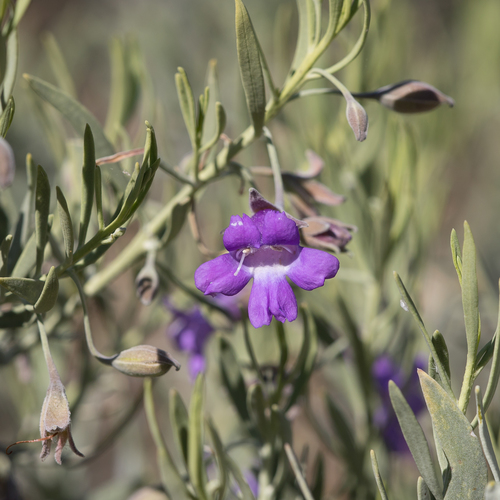
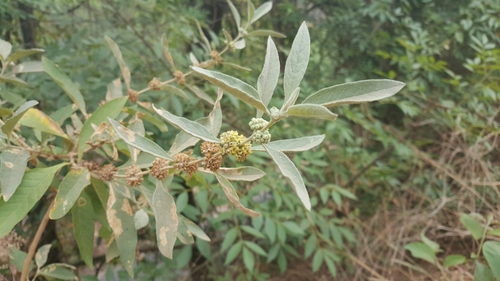
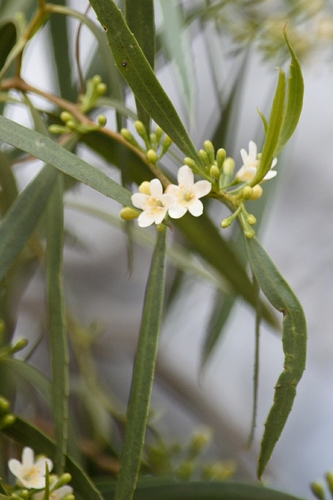
Myoporum platycarpum R.Br., commonly known as sugarwood, is a rounded shrub or small tree that reaches up to 10 m (30 ft) in height. Its foliage and branches are glabrous, but often covered with small, raised, wart-like tubercles. Mature individuals have rough, dark grey, flaky bark. Leaves are arranged alternately, typically 37–72 mm (1–3 in) long and 4–9 mm (0.2–0.4 in) wide. They are linear to elliptic in shape, usually with small teeth or serrations on the outer half, and often curved or hooked at the tip. Both leaf surfaces are a deep green colour. Flowers grow in groups of around 5 to 8, sometimes with more or fewer flowers per group, on a stalk 3.8–7.2 mm (0.1–0.3 in) long. Each flower has five triangular sepals and five petals that are joined at the base to form a tube. Petals are white, very pale pink, or purple, and sometimes spotted orange or yellow. The petal tube is about 1.9–4 mm (0.07–0.2 in) long, with spreading, blunt lobes 1.6–4.8 mm (0.06–0.2 in) long. The inside of the tube and part of the lobes are hairy. Four stamens extend beyond the petals. The main flowering season runs from August to November. Fruits are green and fleshy when young, and become dry when they reach maturity.
Both subspecies of Myoporum platycarpum grow in inland areas of New South Wales, north-western Victoria, and the southern half of South Australia. Only subspecies platycarpum is found in south-eastern Western Australia and the far south-east of Queensland. This species often grows in mallee or Belah woodland.