About Myophonus horsfieldii Vigors, 1831
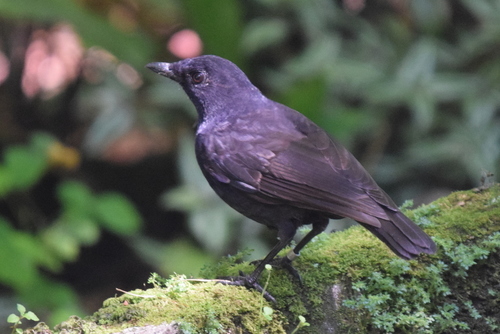
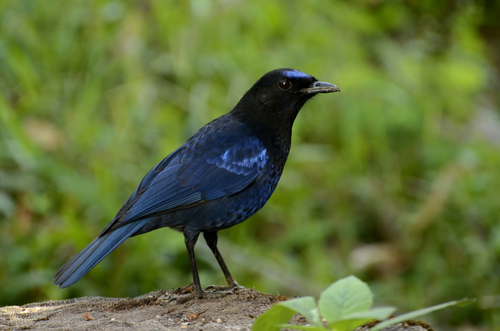
This species, Myophonus horsfieldii, commonly known as the Malabar whistling thrush, is a large thrush that measures about 25 to 30 cm in length and weighs approximately 101 to 130 g. Males have blackish upper bodies with shiny metallic blue patches on the forehead and shoulders, and glossy royal-blue scaling on the back, scapulars, and from the mid-breast to the belly. Both the bill and legs are black. Females are very similar in appearance to males, but have weaker scaling on their underparts. Juveniles are black, with a glossy blue shoulder patch and blue edgings on the wings. The blue coloration, which becomes visible only in oblique lighting, is produced by ultraviolet reflectance, a trait shared with other whistling thrushes.
Malabar whistling thrushes typically inhabit dark undergrowth in dense riverine forest. They forage along the margins, beds, and adjacent ground of rocky hill streams and rivers, found in forest, secondary growth, and plantations ranging from foothills up to 2200 m above sea level; they move down to the plains during the rainy season. The species occurs along the entire Western Ghats south of the Surat Dangs. It is also found along the Satpura range extending to Chhattisgarh, in northwestern Orissa (including Surguja and Simlipal National Park), and occurs locally in the Eastern Ghats. Populations are not migratory, but are known to disperse widely during winter. One individual ringed in Mahabaleshwar in summer 1972 was recovered in winter 1976 in Sampaje, Coorg. While the species was historically recorded twice at Mount Abu, more recent surveys have not found the bird or suitable habitat for it at this location.
Malabar whistling thrushes are most often seen singly or in pairs. In areas with suitable habitat, they are frequently found close to human habitation. During the summer, males sing a varied, melodious whistling song from trees. They may sing for long periods around dawn, while at other times of day they most often produce sharp, high-pitched single or two-note whistles. They were once popular as cage birds because they have the ability to learn entire tunes. They bathe frequently in water, usually in the mornings and evenings, though they also bathe at midday during hot weather.
The species is omnivorous. It feeds primarily on insects, snails, worms, crabs, and small frogs, and also eats drupes, wind-fallen figs, and berries. Occasionally, individuals have been recorded eating small snakes, and there are rare records of them eating longer snakes such as the rat snake.