About Myodes glareolus (Schreber, 1780)
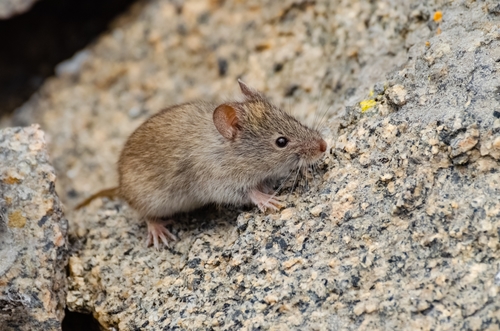
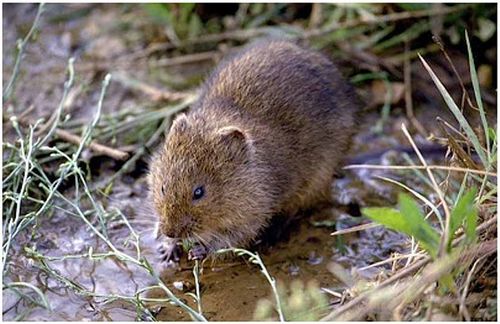
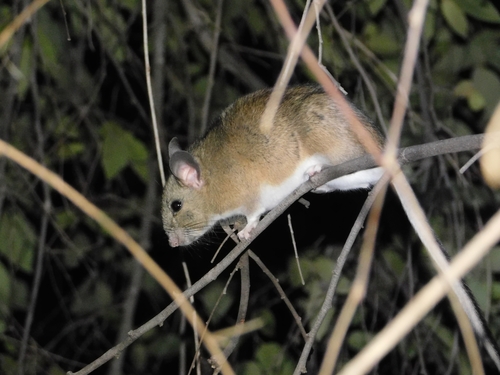
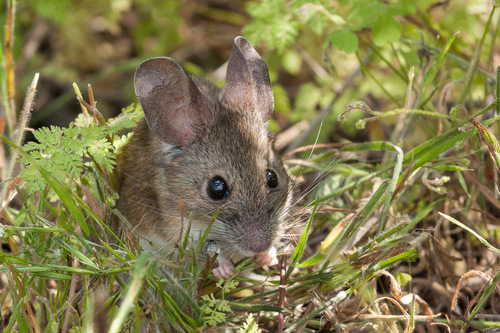
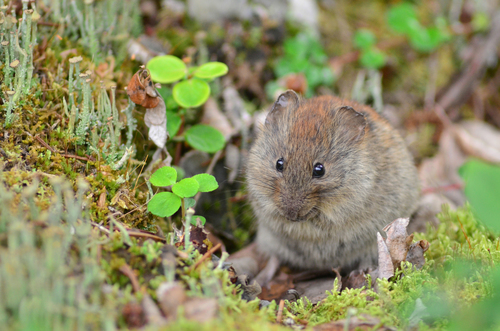
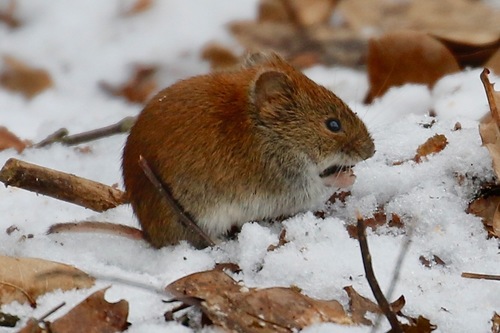
The bank vole (Myodes glareolus) is a small rodent. Young individuals closely resemble mice, while adults develop a stouter body, a slightly rounder head with smaller ears and eyes, and a shorter, hairy tail. Its dorsal surface is reddish-brown with a greyish undercoat, and the flanks are grey with a reddish-brown sheen. Its underparts are whitish-grey, sometimes tinged with dull yellow, and its ears are larger than those of most other vole species. Adult head and body length ranges from 3.25 to 4.75 inches (83 to 121 mm), tail length ranges from 1.5 to 3 inches (38 to 76 mm), and adult weight is between 15.4 and 36 grams (0.54 and 1.27 oz). Young bank voles are darker in color, with greyer underparts. Bank voles can produce growling sounds and low-pitched squeaks; when distressed or isolated, they have been observed making a sound that resembles a human sob. In regions like Great Britain, where the only other small vole species is the short-tailed vole (Microtus agrestis), the bank vole can be distinguished by its more prominent ears, chestnut-brown fur, and longer tail, which is usually 50% of the animal's body length. The northern red-backed vole (C. rutilus) of northern Scandinavia and Russia has a shorter tail, is paler in color, and has less grey in its coat than the bank vole. The grey red-backed vole (Craseomys rufocanus) of northern Eurasia is larger than the bank vole, and has a distinctive reddish back. The bank vole has a Palearctic distribution, and is native to Europe, Asia Minor, and parts of Western Siberia. It is not found in Iceland or most of northern Fenno-Scandia, with the exception of Finland; it is also absent from most of the Iberian Peninsula, and from parts of Italy and the Balkans. It was introduced to southwestern Ireland in the 1950s, and there are concerns it may displace the native wood mouse (Apodemus sylvaticus). The Skomer vole (M. g. skomerensis), a subspecies found on Skomer island off West Wales, is much larger than mainland bank voles, and the island may host up to 20,000 Skomer voles by late summer. The bank vole occurs in forests, particularly deciduous and mixed woodland with scrub, low plants, and leaf litter. It can also be found in hedgerows, field verges, areas of bracken and brambles, river banks, swamps, and parks. In mountainous regions and the northern portion of its range, it lives in coniferous woodland at altitudes up to 1,800 metres (5,900 ft). It does not live on bare soil, and requires ample ground cover to survive. At the southern edge of its range in the Mediterranean region, it is a habitat specialist that only lives in moist woodland, and is not found in grassland or bushy areas. At the edges of forested areas, bank voles may form a metapopulation: multiple spatially separated populations that appear and disappear based on season and local conditions. Some areas may have no bank voles during winter, become repopulated in summer, and then empty again by October. The further a location is from a permanently forested, permanently occupied area, the fewer female bank voles it holds, and the more the total population size fluctuates. Bank voles are abundant through most of the year, and form an important part of the diet of many predators, including the red fox (Vulpes vulpes), stoat (Mustela erminea), least weasel (M. nivalis), European mink (M. lutreola), common kestrel (Falco tinnunculus), rough-legged buzzard (Buteo lagopus), and tawny owl (Strix aluco). To avoid predation, bank voles avoid open ground, and travel using tunnels and well-worn paths through undergrowth. The bank vole acts as a reservoir for Puumala virus, which can infect humans, causing the haemorrhagic fever nephropathia epidemica, and can even cause death in extreme cases. Although this hantavirus has co-evolved with the bank vole, infection in a bank vole population decreases the population's over-winter survival rate.