About Myobatrachus gouldii (Gray, 1841)
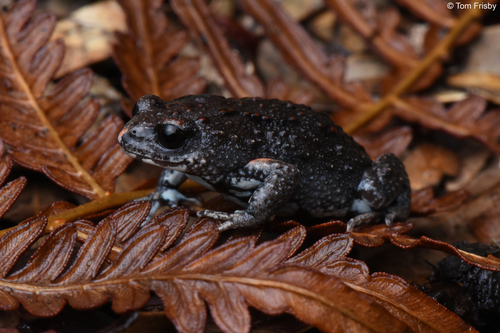
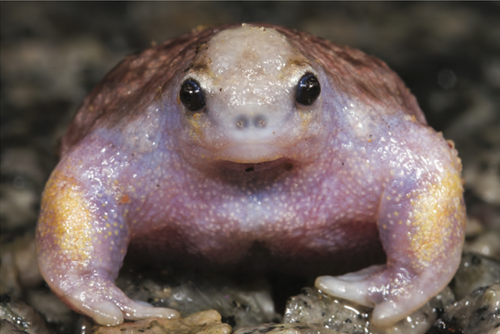
The genus Myobatrachus is a group of frogs native to Western Australia, and it is monotypic, meaning it contains only one single species: Myobatrachus gouldii, which is commonly called the turtle frog. This species gets its common name from its resemblance to a turtle without a shell. It has an extremely small, narrow head, short limbs, and a round body, and can grow up to 45 millimetres, or 1.8 inches, in length. Anatomical studies of the species have found that it has an unusually large pectoral girdle relative to its body size. Due to its unusual physical form, its distinctive features are thought to be inherited from early frog lineages that date back to the early Tertiary or late Mesozoic eras. The turtle frog occurs only between Geraldton and the Fitzgerald River in the Perth region of southwestern Australia, and has not been recorded anywhere else in the world. This area is primarily semi-arid, and the species has adapted specifically to this region. Even with its restricted range, the turtle frog is currently classified as a species of least concern for extinction. Like most frogs, the turtle frog emerges from underground into the open during rain or storms. It has developed short, muscular limbs that help it dig into sand; unlike most digging frogs, it digs forward, in the same manner as a turtle. Its diet consists mainly of termites, so its muscular digging limbs and large pectoral girdle are useful for penetrating termite mounds. The turtle frog does not need to live near standing pools of water, because it completes its entire metamorphosis while inside the egg. Individuals hatch from their eggs as fully formed frogs, completely skipping the tadpole stage. This unusual life cycle is shared by a small number of other frog genera, including Eleutherodactylus, Arenophryne, and other members of Myobatrachus's own genus. The closest relatives of the turtle frog, which share most of its distinctive traits, are sandhill frogs and forest toadlets.