About Mylopharodon conocephalus (Baird & Girard, 1854)
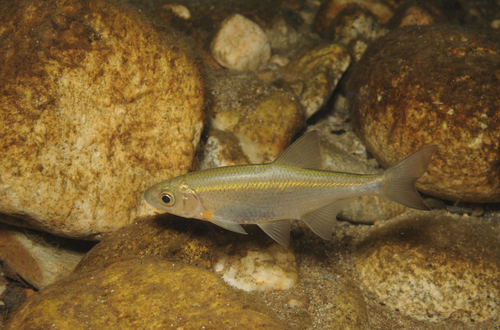
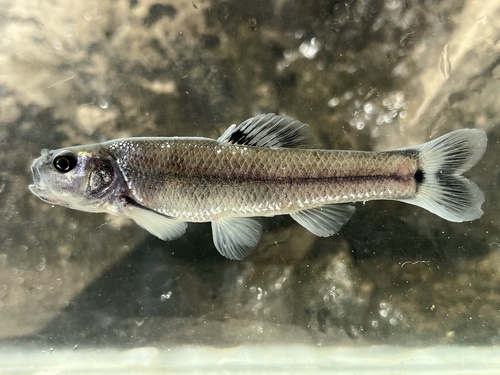
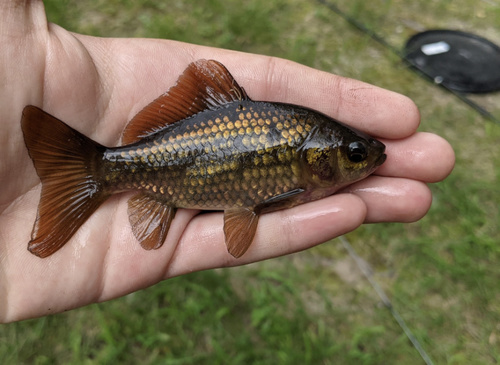
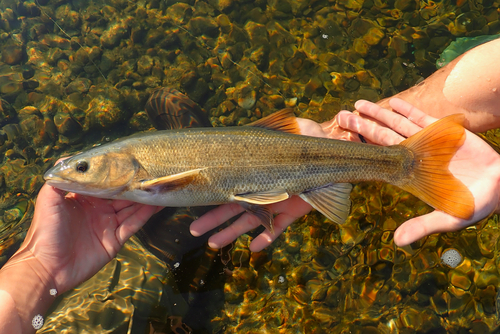
This species is commonly called hardhead, with the scientific name Mylopharodon conocephalus (Baird & Girard, 1854). Hardheads have an elongated, slender body. Their upper body is brown to dusky bronze, with larger individuals being darker, and their sides are silver; juvenile hardheads are fully silvery. This species has 69–81 scales along its lateral line, 8 rays in its dorsal fin, and the origin of the dorsal fin sits behind the origin of the pelvic fin. Its jaws are not extendable, and it has a premaxillary frenum. The snout is long and pointed, and it ends in a large terminal mouth that extends back to the front of the eye. Hardheads have 2.5 to 4.2 pharyngeal teeth, and reach approximately 30 centimetres (12 inches) in standard length. During the spring spawning season, adult males develop small white nuptial tubercles on the head, along a band that extends from the head to the caudal peduncle. The hardhead’s native range covers most of the Sacramento and San Joaquin drainage basin in California, USA, where it is widely distributed in foothill streams. The southern end of its range is the Kern River in Kern County, and it extends north to the Pit River drainage in Modoc County. It is not found in the Clear Lake basin, nor in most streams draining into San Francisco Bay, except for the Napa River and Russian River, where it is uncommon. Hardhead habitat consists of deep pools with rocky or sandy substrates in small to large rivers. They prefer relatively undisturbed habitats, and are typically found in larger streams at low to mid-elevation. They specifically favor deep, clear pools with sand, gravel or boulder substrates and slow current. They can occur in some mid-elevation reservoirs, but their reservoir populations are usually temporary: populations may grow large, then rapidly decline. Hardheads typically occupy the lower half of the water column in rivers and streams, but they can be found near the surface in slower or still water such as reservoirs. They are always found alongside Sacramento pikeminnow (Ptychocheilus grandis), and are normally also found with Sacramento sucker (Catostomus occidentalis occidentalis). They are not typically found in waters where non-native alien species, especially sunfish, are the dominant fish community.