About Mylocheilus caurinus (Richardson, 1836)
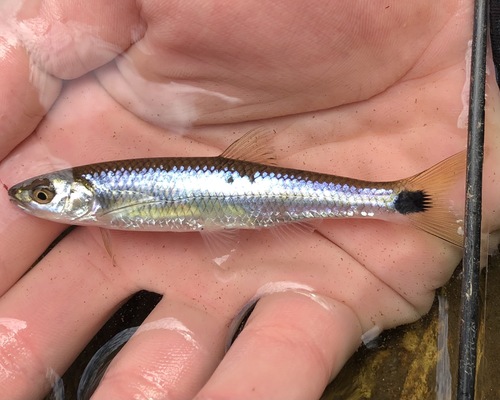
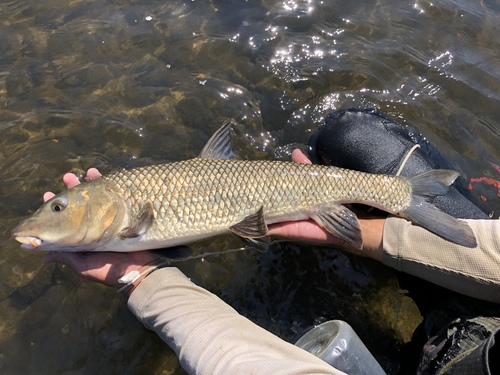
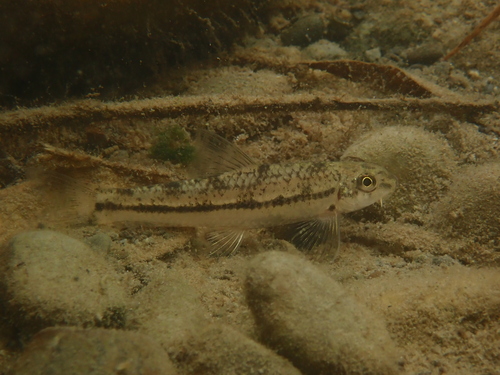
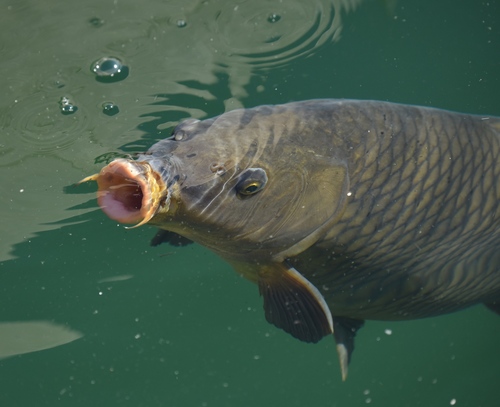
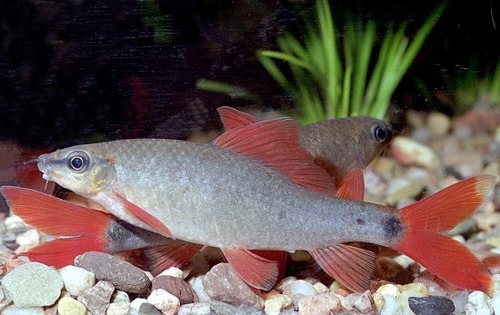
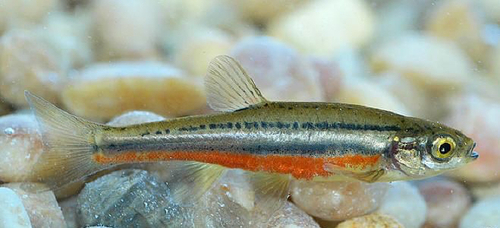
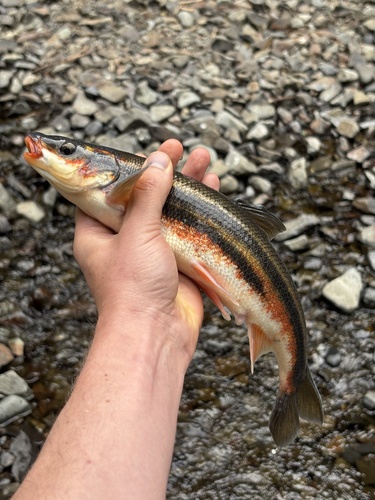
The peamouth, Mylocheilus caurinus, is a slender fish with a somewhat compressed body, a subterminal mouth, large eyes, a rounded snout, and a forked tail. It has a dark back that contrasts with silvery underparts, with two dusky longitudinal stripes running between the two color zones. The corners of the mouth are reddish, and small barbels are located at these corners. When breeding, mature males develop a red stripe along their sides, as well as red coloration on the belly, mouth, gill cover, and pectoral fin base. Both the dorsal fin and anal fin each have 8 soft rays, and the lateral line contains 66 to 84 scales. This species can reach a maximum total length of 36 centimetres (14 inches).
Peamouth are distributed across western North America. Their range extends from the Mackenzie River in the Northwest Territories, through the Nass River and Peace River in British Columbia, to the Columbia River drainage that covers Washington, Oregon, Montana, and Idaho. The species is relatively tolerant of salt water, which has allowed it to colonize rivers on Vancouver Island and other islands off the coast of British Columbia. It has also been introduced to Redwood National Park in California.
Peamouth inhabit the shallow, weedy zones of lakes and rivers, and are most commonly found among aquatic vegetation. They usually stay near the bed at depths of less than 18 m (60 feet), though they move to deeper parts of lakes during winter.
Peamouth have been used as a food fish by people in the past, and are still targeted by recreational anglers. In Bellevue, near Seattle, an online alert system notifies interested people by email when peamouth are observed spawning in local streams, so they can come view the spawning spectacle.