About Myliobatis tenuicaudatus Hector, 1877
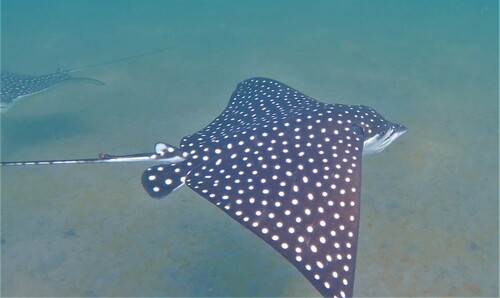
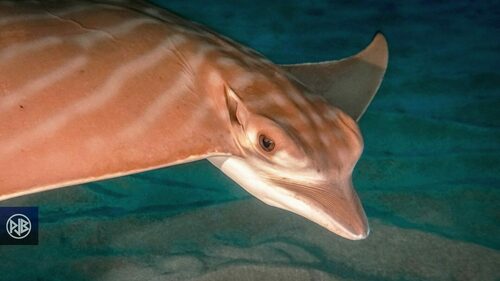
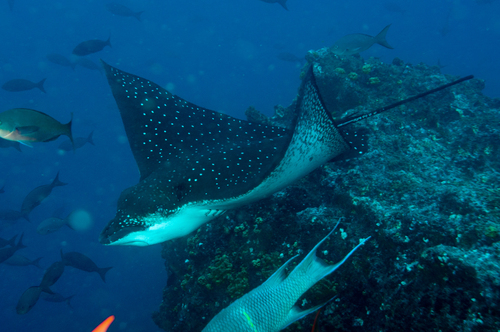
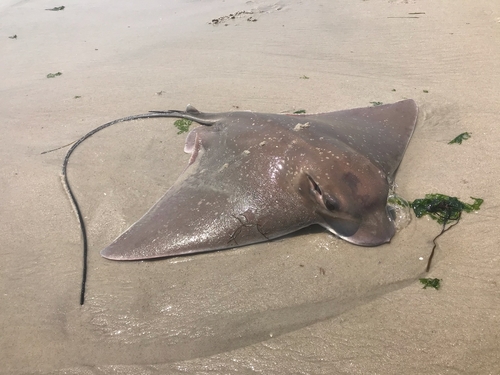
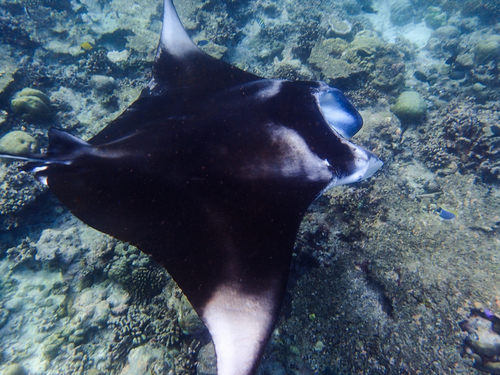
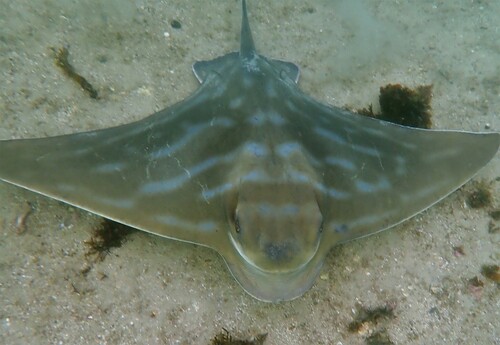
The New Zealand eagle ray (scientific name Myliobatis tenuicaudatus Hector, 1877) is a cartilaginous fish. It has a roughly circular disc-shaped body, a protruding frog-like head, large fleshy pectoral fins, and a long tail armed with a venom-injecting spine. Its pectoral fins beat up and down, giving the fish the appearance of "flying" through the water. This species can reach a maximum disc width of around 150 cm (60 in), and females are typically larger than males. Its dorsal surface is olive-green, dark brown, or yellowish with grey or pale blue markings, while its ventral surface is white. This ray is native to waters around New Zealand's North Island, South Island, Kermadec Islands, Norfolk Island, and southern Australia, including the coastal waters of Queensland, New South Wales, Victoria, Tasmania, South Australia, and Western Australia. It most commonly occurs on the inner continental shelf, in habitats including sandy flats, seagrass meadows, estuaries, bays, and areas near rocky reefs. It is usually found in shallow water, but has been recorded at depths as great as 422 m (1,380 ft). It is a benthopelagic species that feeds on benthic invertebrates including clams, oysters, crabs, and worms found on the seabed. It crushes prey with its teeth and rejects hard fragments. It uses electro-sensory organs on its head to detect prey that is fully buried in sand or mud. After detection, it blasts a jet of water from its gill slits to expose the buried prey. This digging activity leaves a steep-sided pit that can measure up to 30 cm (12 in) across, and these pits are commonly visible in shallow water during summer. This species gives birth to live young. Litter sizes range from two to twenty offspring, with an average of six. Before birth, developing young first feed on egg yolk, then feed on exudations from the mother's uterus. Newborn rays usually have a disc width of 20 to 30 cm (8 to 12 in) at birth.