About Myliobatis californica Gill, 1865
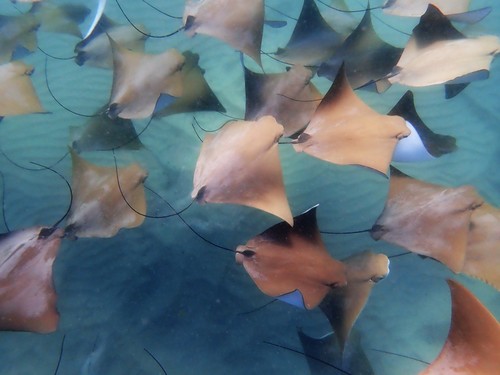
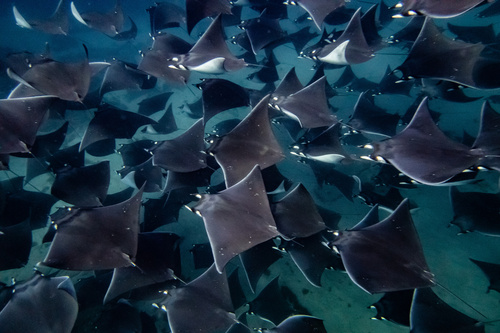
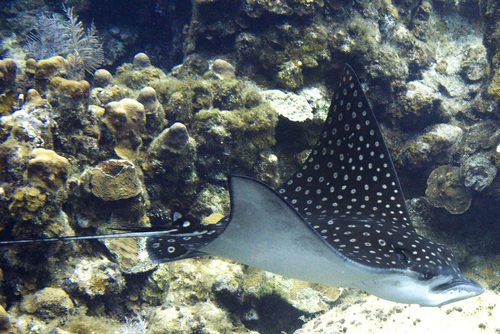
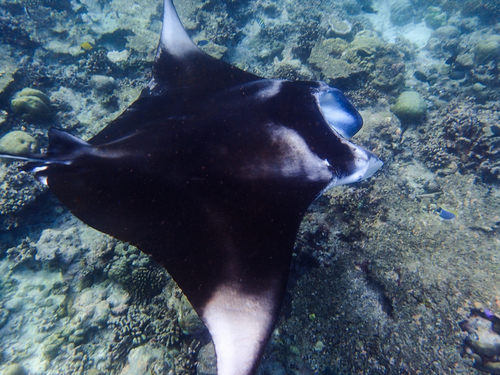
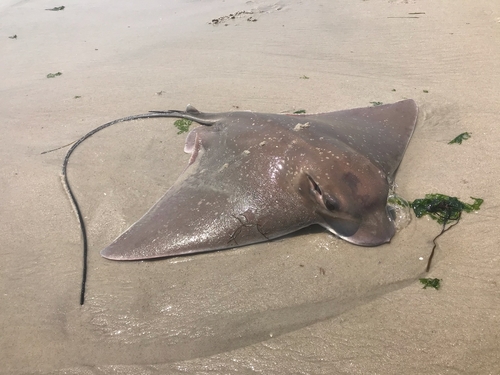
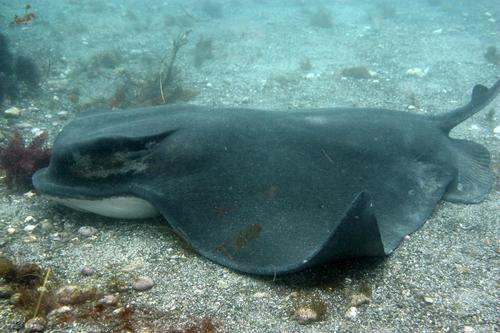
The bat ray (Myliobatis californica) is a type of eagle ray with a diamond-shaped ray-like body. Its pectoral fins are wing-shaped and end in blunt points. The broad head sits higher than the pectoral fins, and its eyes are positioned on the sides of the broad head. A horizontal depression sits below the front of the head projection, which forms a slight indent on the top of the head between the eyes. The bat ray has a whip-like tail that is typically incomplete, with at least one venomous spine at its base. The incomplete tail is made of cartilage rather than bone. The dorsal side of the bat ray is black or dark brown, while its ventral side is white, except for areas near the fin tips or body disk. The largest recorded specimens can reach a 1.8 meter (5 feet 11 inches) wingspan and a mass of 91 kg (201 pounds), with an unconfirmed record of a 240-pound individual; large specimens are typically closer to 200 pounds, while most individuals weigh between 9.07 and 13.61 kg (20.0 to 30.0 pounds). Bat ray size depends on multiple factors, including habitat changes and varying oceanographic and environmental conditions. Some bat rays are solitary, while others form schools that can number in the thousands. Only one case of albinism in this species has ever been recorded: an individual found off the west coast of Baja California, Mexico in 1865. One record exists of abnormal cephalic horn formation in a juvenile male bat ray on the coast of Baja California Sur, Mexico. This specimen had three cephalic horns: one in the central rostral area and two in the cephalic lobe zone. This abnormality may indicate morphogenetic plasticity in the species, which can provide insight into how evolution occurs in other ray species. Morphogenetic plasticity describes the ability of organisms to change their physical structures in response to genetic mutations or environmental factors, and this example can help researchers understand what factors may drive such structural changes. Cephalic horns are flexible projections extending from the front of the bat ray’s head, and they are modified forms of the species’ pectoral fins. Bat rays use these structures to push food into their mouths while feeding. Most bat rays only have two cephalic horns, which are smaller and less developed than those of other ray species. Bat rays can be found in both tropical and temperate oceans, ranging from central Oregon, USA, south to the Gulf of California in Mexico, and around the Galápagos Islands. They inhabit muddy or sandy sloughs, estuaries, bays, kelp beds, and rocky-bottomed shorelines, and are typically found in flat water areas with sand patches between rocks or rocky bottoms. They are common in inshore bays and sloughs, and around offshore islands including San Clemente, Anacapa, and Santa Rosa. They have been observed at San Clemente during spring and summer, are common in the shallow waters of Santa Rosa in March and April, and are common in shallow waters around Anacapa Island during the summer. They can live from the ocean surface down to 150 feet below the surface, and are most concentrated between 8 and 100 feet deep. Bat ray reproduction is ovoviviparous: females retain their eggs, which hatch inside the female’s body, resulting in a process that resembles live birth. The species also has histotrophic viviparity, meaning embryos develop inside the oviduct and get their nutrition from uterine secretions rather than a yolk sac, and do not require a placenta to grow during gestation. Bat rays mate once annually in spring or summer, with a gestation period of nine to twelve months. After gestation, female bat rays give birth to live pups. Litter sizes can range from two to ten pups. Pups emerge tail-first with their pectoral fins wrapped around their bodies; the venomous tail spine is flexible at birth and covered by a sheath that sheds off within hours of birth. Bat rays can live up to 23 years. Bat rays copulate while swimming with synchronized wingbeats, with the male positioning himself below the female. The male inserts a clasper into the female’s cloaca to channel semen and fertilize her eggs. Female bat rays reach sexual maturity at a larger size than males. For males, sexual maturity occurs at a disc width (tip-to-tip measurement of the pectoral fins) of 622 mm, a weight of approximately 3.7 kg, and an age of 2 to 3 years. Once males reach sexual maturity, there is an abrupt shift in the relationship between clasper size and disc width, which leads to the growth of 2 to 6 cartilaginous elements at the distal end of the clasper. For females, full sexual maturity is reached when they reach 63% of their asymptotic disc width, at an age of approximately 5 to 6 years. Female bat rays have a largely nonfunctional right ovary, but both their right and left uteri work normally. Females can carry four size classes of ova, and larger females produce larger eggs in greater numbers. Bat rays have low fecundity. Newborn bat rays range from 220 to 305 mm in disc width. Most breeding occurs during the summer, following an annual reproductive cycle. Breeding behavior has been observed in August at 20 feet depth on a sandy-bottom rock reef in Baja California, where two small males followed beneath a medium-sized female while pushing her genital region. The same behavior was also observed in August at 15 feet depth at the Scripps Institute of Oceanography. In these regions, young are born in late summer or early fall, and subadult bat rays are most abundant close to shore during the summer. A documented breeding position has the male positioned slightly behind and below the larger female, both swimming slowly in synchronization. The male’s tail is held dorsally at a 90-degree angle, while one clasper is extended dorsally at a 45-degree angle. The male moves back and forth repeatedly to get closer to the female’s underside to insert his clasper into her cloaca.