About Myliobatis aquila (Linnaeus, 1758)
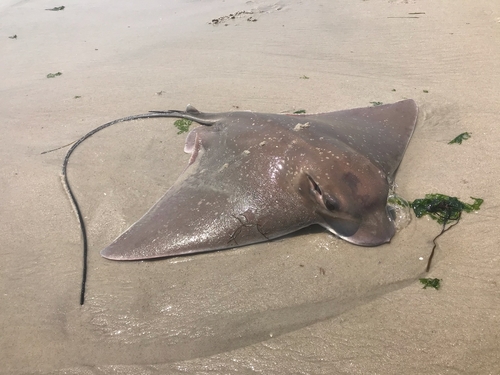
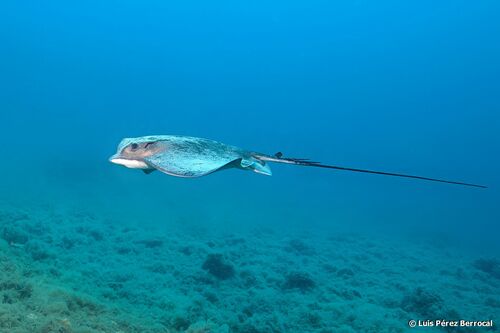
The common eagle ray, Myliobatis aquila, reaches a maximum total length of 183 cm (6.0 ft) and a maximum disc width of 80 cm (2.6 ft), though most individual specimens are smaller. Females of this species grow larger than males. Its dorsal surface is colored brown or black, while its ventral surface is white. It has a rhomboidal disc, with a pair of large triangular pectoral fins projecting from either side, plus one single dorsal fin. It has a blunt, rounded snout, and a long slender tail that has a large spine at its base but no tail fin. On average, the tail spine has 72 serrations in males and 66 serrations in females. The spine makes up approximately 70% of the total male body length, and 65% of the total female body length. A mid-dorsal groove, which holds the glandular tissue required for venom injection, extends along 10 to 40 percent of the tail length. This groove has one or two excretory channels for the venom. This species is found in the eastern Atlantic Ocean, from the British Isles south to South Africa, and it also occurs in the North Sea and extends into the Indian Ocean. It is additionally present in the Mediterranean Sea. It can be found both close to shore and further offshore, at depths down to around 800 m (2,600 ft), but spends most of its time in shallower water less than 50 m (160 ft) deep. It typically prefers open sandy habitats. It has also been recorded in a semi-enclosed lagoon on Gran Canaria Island, especially between March to April in winter and August to October in summer; in this lagoon it was found to prefer rocky and mixed sea floors. During the reproductive period, this species gathers in groups of dozens of individuals. Its reproduction is ovoviviparous: a clutch of three to seven young develops inside the mother. The young first receive nourishment from their egg yolks, and later receive nourishment from fluids secreted by the mother into her uterus. Gestation lasts between 6 and 8 months, after which the female gives birth to three to seven live pups. The smallest juveniles were caught between May and September off the coast of France; these individuals still had an unhealed scar on their lower surface, indicating they were recently born neonates. A 1983 study conducted in South Africa found juveniles of this species in November. Juveniles have also been found at Gran Canaria Island in October.