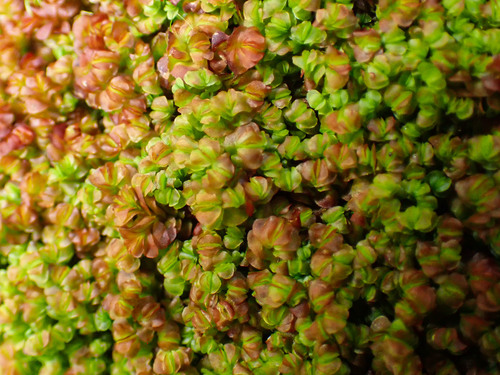
About Mylia taylorii (Hook.) Gray
Mylia taylorii (Hook.) Gray forms dense mats or hemispherical colonial growths made of vertical shoots, which have a swollen, slimy appearance when damp. The shoots are yellow-green tinged with brown or red, and reach 3–8 cm tall. Leaves grow up to 2.4 mm long, and become close and overlapping toward the shoot tips. The rounded leaves have an entire margin, attach obliquely to stems, and are succubous. Small narrow underleaves are also present. Asexual reproduction occurs via gemmae, which can be found on the margins of upper leaves. Mylia taylorii is dioecious, but fertile plants are uncommon in Britain. It produces dark brown, ovoid-globose capsules. Mylia taylorii occurs in mountainous districts of northern Europe, the mountains of Continental Europe, Greenland, and eastern North America from Newfoundland to Tennessee. Scattered records exist for western North America and eastern Asia. It is probably most common in Great Britain and Scandinavia. This species typically grows on peaty banks, tree bases, rock faces, screes, and open woodland in high rainfall climates. Per Ratcliffe's account of oceanic bryophytes bordering the Atlantic, M. taylorii is classified as a Western British species. The distribution of Mylia taylorii is limited by its requirement for at least 120–140 wet days per year. In Britain, it is often found in widespread derelict upland forests of sessile oak (Quercus petraea) and downy birch (Betula pubescens), which are managed as poor sheep pasture with scattered trees, in the uplands of Western Britain. Mylia taylorii is consistently calcifugous in its choice of substrate.

