About Myiornis ecaudatus (Orbigny & Lafresnaye, 1837)
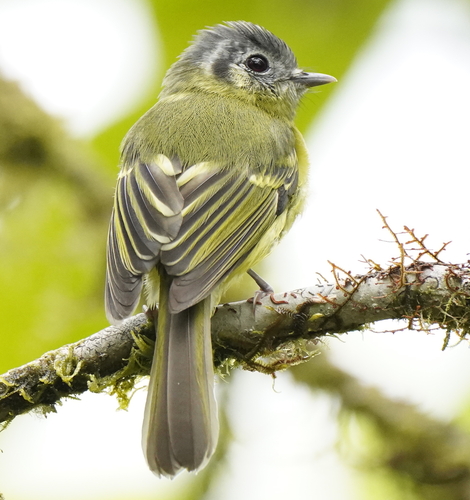
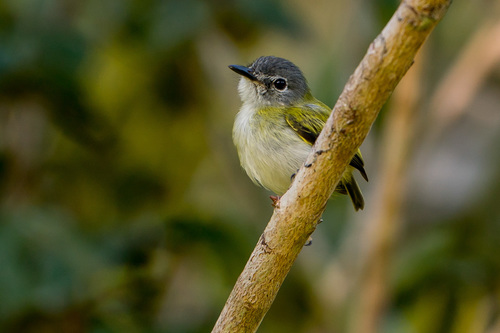
The short-tailed pygmy tyrant (Myiornis ecaudatus) measures 6 to 7 cm (2.4 to 2.8 in) long and weighs approximately 4.2 g (0.15 oz). It is the smallest passerine on Earth. Males and females have identical plumage. Adults of the nominate subspecies have a mostly dark gray head with blackish lores, a distinct white spot above the lores, and a white eye-ring; the white spot and eye-ring create a spectacled appearance. Their back, rump, and uppertail coverts are bright olive green. Their wings are dusky, with bright olive edges on the flight feathers and bright olive tips on the coverts; the tipped coverts form two faint wing bars. They have an extremely short, mostly black tail. Their throat and underparts are white, with a pale yellow tinge on the crissum. Their iris is brown to dark, their bill is black and unusually long for a bird of their size, and their legs and feet are pinkish. Subspecies M. e. miserabilis has a darker, duller green back than the nominate subspecies, along with a darker gray crown and nape, grayer or pale olivaceous breast sides, and darker legs. Juveniles of both subspecies have the same appearance as adults of their respective subspecies. The short-tailed pygmy tyrant resembles the larger slate-headed tody-flycatcher (Poecilotriccus sylvia), but 'is much more likely to be mistaken for a large beetle or insect, especially in flight, than another bird'.
The short-tailed pygmy tyrant is primarily native to the Amazon Basin, though it also occurs outside this region. The nominate subspecies is found on Trinidad, and ranges from the southeastern third of Colombia eastward through the southern half of Venezuela, the Guianas, and northern Brazil located north of the Amazon and east of the upper Negro River. It also occurs in the Andes of northwestern Venezuela and in coastal areas of Venezuela's Carabobo and Sucre states. Note that the map included in McMullan's Field Guide to the Birds of Colombia shows a far more extensive range within Colombia than maps from other sources. Subspecies M. e. miserabilis is found in eastern Ecuador, eastern Peru, northern and eastern Bolivia, and Brazil south of the Amazon.
This species lives in the interior, edges, and gaps of humid forest, and also occupies nearby secondary and transitional forest in lowlands and Andean foothills. Its elevation range varies by country: it occurs below 500 m (1,600 ft) in Colombia, below 400 m (1,300 ft) in Ecuador, below 1,000 m (3,300 ft) in Peru, and below 950 m (3,100 ft) in Brazil. In Venezuela, it occurs below 500 m (1,600 ft) north of the Orinoco River, and below 900 m (3,000 ft) south of the river.