About Myiopsitta monachus (Boddaert, 1783)
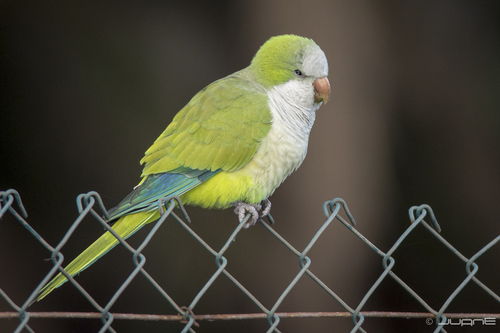
The nominate subspecies of this parrot averages 29 cm (11 in) long, with a wingspan of 48 cm (19 in), and weighs 100 g (3.5 oz). Females are typically 10–20% smaller than males, but reliable sex identification can only be done through DNA or feather testing. Monk parakeets have very subtle sexual dimorphism in the colouration of their crown and wing coverts, but this difference is not visible to the human eye. The species has bright-green upperparts. Its forehead and breast are pale grey with darker scalloped patterning, and the rest of its underparts range from very light-green to yellow. Its flight feathers are dark blue, its tail is long and tapering, and its bill is orange. Its call is a loud, throaty chape(-yee) or quak quaki quak-wi quarr, with screeches sounding like skveet. Domestic captive breeds of monk parakeet have been developed with plumage colours other than the natural wild-type, including variants that have white, blue, or yellow plumage in place of the natural green. Because these non-natural colours provide less camouflage, feral wild-living monk parakeets almost always have the original wild-type colouration. In its native range, the monk parakeet is very common. In Argentina, Brazil, and Uruguay, monk parakeets are considered major agricultural pests, a fact that was noted by Charles Darwin among others. Their population boom in rural areas of South America appears to be linked to the expansion of eucalyptus forestry for paper pulp production; these artificial forests give the birds protected sites to build nests, while ecological competition from other species is limited. The monk parakeet and the cliff parakeet are the only two parrot species outside of some members of the African lovebird genus Agapornis that build nests. Even among nesting parrots, monk and cliff parakeets are unique for building large, external nests in trees or on human-made structures, instead of using pre-existing tree cavities. The monk parakeet is a gregarious species that often breeds colonially, building a single large communal nest with separate entrances for each breeding pair. It is not uncommon for pairs or individual monk parakeets to nest outside of colonies, especially during the breeding season. In the wild, colonies can grow quite large, with pairs occupying separate "apartments" within composite nests that can reach the size of a small automobile. These large nests can attract many other tenants, some of which cohabitate with the monk parakeets. Tenant species include many other birds, such as pigeons, sparrows, American kestrels, and yellow-billed teal, and mammals including red squirrels may also move into the nest. Monk parakeets lay between 1 and 11 white eggs, which are incubated continuously by the female; during incubation, the male provides the female with food. Unusually for a parrot, monk parakeet pairs occasionally have helper individuals, most often grown offspring, that help feed the young. Monk parakeets have an average lifespan of 6 years in their natural native environment, while birds kept in captivity can live between 10 and 20 years. Research suggests monk parakeets have individual voice prints that allow them to recognize each other, regardless of the type of call being used. In both their native South America and introduced regions, monk parakeets are counted among the most destructive bird species for agricultural crops. Several countries have put in place measures to control the spread of feral wild-living populations. Nest removal is a common practice in the United States, and the United Kingdom's Department for the Environment, Food and Rural Affairs plans to remove monk parakeet colonies, citing threats to infrastructure and potential crop damage. Feral populations are most often descended from very small founding populations. As social, intelligent birds, monk parakeets develop cultural traditions, specifically vocal dialects that differ between separate groups. In populations that descend from a large number of founding birds, a range of distinct dialects exist. When the founder population is small, a process similar to genetic drift can occur: if prominent founding members vocalize with an unusual dialect, that specific vocal pattern becomes established in the resulting feral colony. As an example, at least three different distinct dialects are found among feral monk parakeets in the Milford, Connecticut, metropolitan area.