About Myiodynastes luteiventris P.L.Sclater, 1859
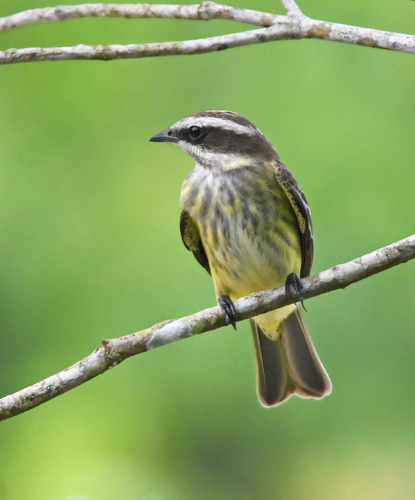
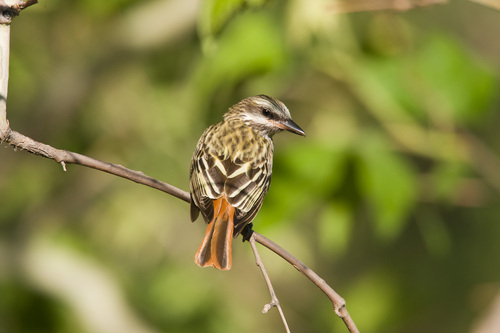
The sulphur-bellied flycatcher (Myiodynastes luteiventris P.L.Sclater, 1859) measures about 20 cm (7.9 in) in length and weighs approximately 40 to 57 g (1.4 to 2.0 oz). Both sexes share identical plumage. Adults have a pale hoary gray or grayish white forecrown and supercilium, with a brownish gray to olive crown marked by blackish streaks and a large, usually hidden, canary-yellow patch at the center of the crown. They have dusky lores that extend to the ear coverts, forming a dark 'mask'. Below the mask lies a wide white stripe with thin dusky streaks, and an additional thin dusky stripe below that. The nape, upperparts, and upper rump are light olive with a buffy tinge, and dusky feather centers create a streaked appearance. The lower rump and uppertail coverts are cinnamon-rufous with dusky streaks. The wings are dusky, with wide yellowish white to primrose yellow edges on the outer webs of the median and greater coverts and inner secondaries. The inner webs of the median coverts have wide grayish olive to buffy grayish edges, the outer greater coverts have a pale cinnamon wash, and the outer webs of the primary coverts and primaries have thin pale olive to buffy grayish edges. The tail is mostly cinnamon-rufous, with dusky shafts that appear as streaks. The chin and sides of the throat are grayish olive with dusky streaks, and the rest of the throat is white with dusky streaks. The remaining underparts are primrose-yellow to sulphur-yellow, with wide coarse black or dusky streaks on the breast and thinner streaks on the sides and flanks. Adults have a brown to dark brown iris, a dusky or blackish bill with a dusky white base to the mandible, and dusky, plumbeous, or black legs and feet. Juveniles have little to no yellow crown patch, a strong brownish buffy tinge to their upperparts, and cinnamon-buff edges on the wing coverts and secondaries.
The sulphur-bellied flycatcher breeds in the Madrean sky islands of southeastern Arizona, and ranges south from there through western Mexico to central Costa Rica. It also breeds from southern Nuevo León and southern Tamaulipas in northeastern Mexico, south through eastern Mexico (including the Yucatán Peninsula), to connect with the western breeding range in Guatemala. It is absent from central Mexico, the northern tip of the Yucatán Peninsula, and the area from central Chiapas into south-central Guatemala. During migration, it travels from Costa Rica south through Panama and western Colombia, and winters on the eastern slope of the Andes from northern Ecuador, south through eastern Peru, and across most of north-central Bolivia. There are multiple records of the species in California, central Arizona, New Mexico, and Texas, and a few records in Louisiana, Alabama, and Florida. It has been recorded as a vagrant in Nevada, Massachusetts, and the Canadian provinces of Ontario, New Brunswick, and Newfoundland. In South America, it has occurred as a vagrant in Brazil, Chile, and Venezuela.
Within its breeding range, the sulphur-bellied flycatcher inhabits deciduous forest, gallery forest, and evergreen forest edges in tropical and subtropical zones. In Arizona, it is typically found in riparian canyons. During migration, the species favors somewhat open woodlands and the edges of denser forest. On its wintering grounds, it mostly inhabits riverine forest, but also occurs in disturbed and secondary forest, as well as the edges and canopy of unbroken tropical forest. In Mexico and northern Central America, it mostly occurs at elevations between sea level and about 1,800 m (5,900 ft). In Costa Rica, it breeds up to 2,000 m (6,600 ft) but does not occur in the Caribbean lowlands; migrating individuals have been recorded up to 2,200 m (7,200 ft). It is found below 2,500 m (8,200 ft) in Colombia. In Ecuador it only occurs below 400 m (1,300 ft), while in Peru it ranges between 350 and 1,200 m (1,100 and 3,900 ft).