About Myiodynastes chrysocephalus (Tschudi, 1844)
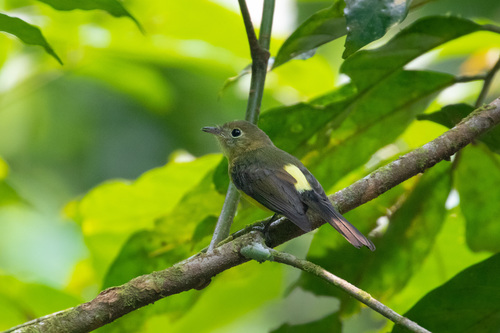
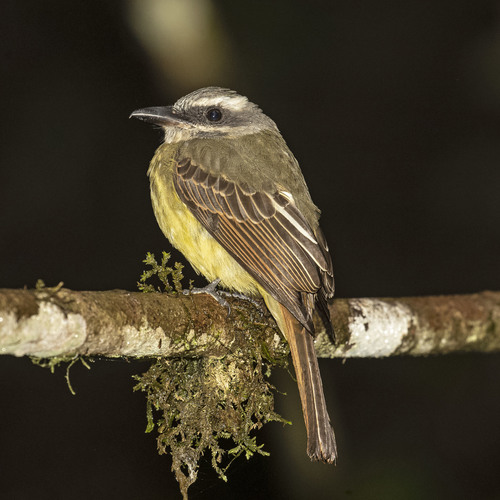
The golden-crowned flycatcher (Myiodynastes chrysocephalus) measures 18.5 to 22 cm (7.3 to 8.7 inches) in length and weighs approximately 37 to 40 g (1.3 to 1.4 oz). Males and females have identical plumage. Adult individuals have a brownish gray to dusky crown, with a usually hidden golden-yellow patch at the crown's center. They have a long white stripe above the eye on a face that is otherwise mostly grayish dusky. Their upperparts are mainly dull olive, with a greenish olive rump and uppertail coverts; the uppertail coverts have cinnamon or buffy edges at their tips. Their wings are dusky, with thin rufous to tawny-buff edges on the coverts and flight feathers. Their tail is mostly dusky, with some rufous edging on the individual feathers. Their chin is white, their throat is pale buffy, their breast is buffy yellow, and the rest of their underparts are pale yellow. The center of their breast has a cloudy suffusion of pale grayish olive or olive, and the sides of the breast have olive streaks. This species has a black to dark brown iris, a stout black bill, and blackish legs and feet. The golden-crowned flycatcher is distributed along the eastern slope of the Andes, starting from south of the Marañon River in Amazonas Department, northern Peru, extending south through central Bolivia and slightly into Salta Province, northwestern Argentina. It inhabits the edges and canopy of foothill and montane forest and woodland, as well as cloudforest. It particularly favors forest openings, both human-made and natural openings caused by landslides and fallen trees. It can also be found along roads and watercourses. In terms of elevation, it occurs between 600 and 2,700 m (2,000 and 8,900 ft) in Peru, and between 350 and 3,100 m (1,100 and 10,200 ft) in Bolivia.