About Myiodynastes bairdii (Gambel, 1847)
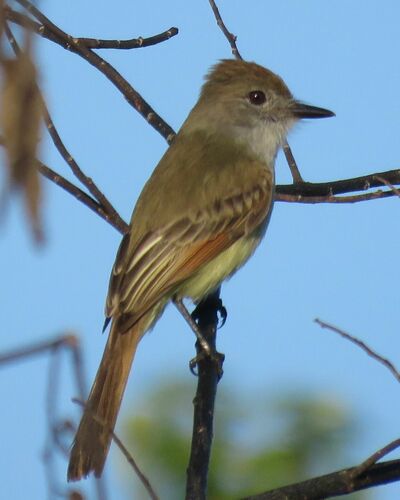
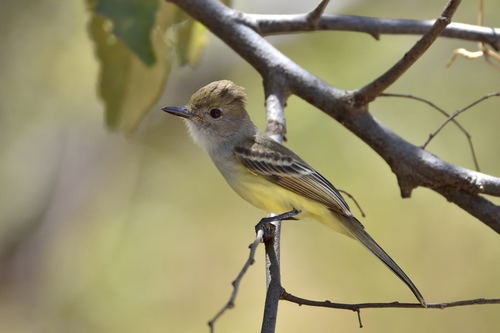
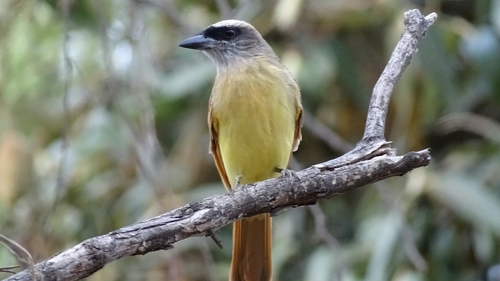
Baird's flycatcher (Myiodynastes bairdii) measures approximately 23 cm (9.1 in) in length; one recorded female individual weighed 45 g (1.6 oz). Males and females have identical plumage. Adult birds have a pale sandy brown to whitish forecrown, and a sandy brown crown marked with light gray streaks that typically holds a hidden yellow patch at its center. They have a broad black "mask" that extends to their dusky ear coverts. Most of their upperparts are olive-brown, with a more rufous-colored rump. Their wings are dusky, with wide cinnamon-rufous edges along the coverts and flight feathers. Their tail is mostly rufous, with some dusky edges on the outermost feathers. Their throat is whitish, with faint, thin grayish streaks. Their breast is pale creamy yellow with an ochraceous tint and faint, thin grayish streaks. Their belly is unmarked pale creamy yellow. They have a chestnut-brown to gray-brown iris, a black bill with a dusky white base to the lower mandible, and gray to black legs and feet.
This species is distributed in lowlands ranging from central Manabí Province in west-central Ecuador, south to the Lima Department of Peru. It lives in somewhat dry deciduous forest and woodlands, gallery forest, secondary forest, arid scrublands, and human towns. In terms of elevation, it occurs from sea level up to 1,000 m (3,300 ft) in Ecuador, and up to 1,200 m (3,900 ft) in Peru.