About Myiobius barbatus (Gmelin, 1789)
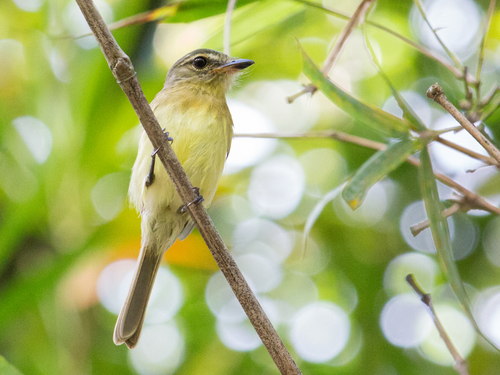
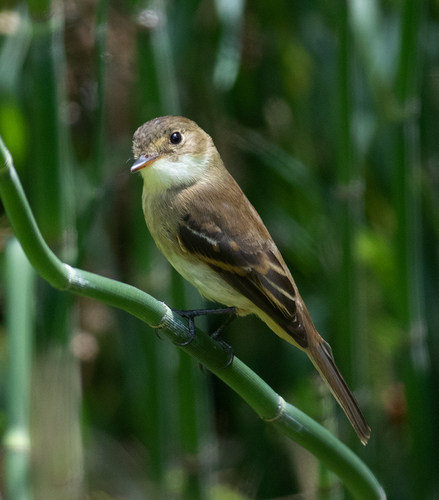
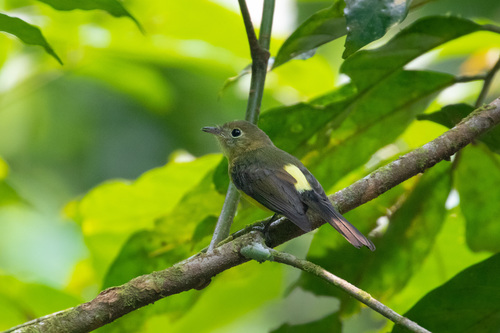
The whiskered myiobius, scientific name Myiobius barbatus (Gmelin, 1789), is very similar in appearance to several of its close relatives. It has olive-colored upper body plumage, a distinct yellow rump, and a yellow patch on the crown that is usually well-concealed. The rictal bristles surrounding its beak are long and form a basket-shaped structure. Its underparts are greyish-olive, and its belly is pale yellow. Its tail is black and somewhat rounded. The species is usually silent, but it will sometimes produce a staccato "psik" call.
This species has a wide distribution across tropical South America. It occurs in the Amazon basin, found in the northern half of Brazil, northeastern Peru, eastern Ecuador, eastern Colombia, southern Venezuela, Guyana, Suriname, and French Guiana. Its typical habitat is the lower canopy of humid rainforest at altitudes below 900 m (3,000 ft). Compared to the black-tailed myiobius (M. atricaudus), it is more often found in the interior of forests, and in Amazonia it occurs at lower elevations than the tawny-breasted myiobius (M. villosus).
Like other members of the myiobius genus, its diet consists mostly of insects, many of which it catches aerobatically while in flight. It often forages as part of small mixed-species flocks. When perched, this bird frequently droops its wings and fans its tail feathers in a display that resembles the behavior of Old World fantails of the genus Rhipidura.