About Myiarchus yucatanensis Lawrence, 1871
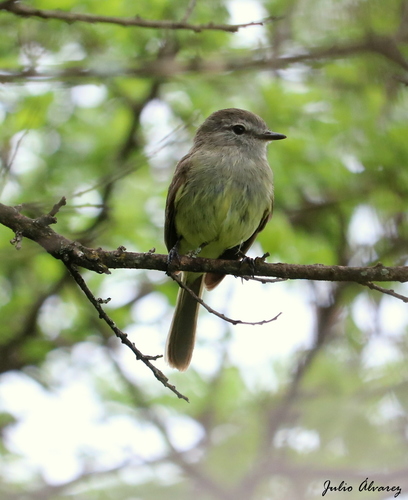
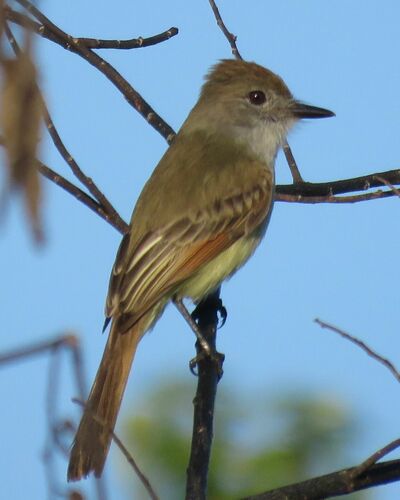
Myiarchus yucatanensis, commonly called the Yucatan flycatcher, measures 17.5 to 19 cm (6.9 to 7.5 in) long and weighs 19 to 23 g (0.67 to 0.81 oz). The sexes of this species have identical plumage. Adult nominate subspecies have a crown made of feathers with dark brown centers and wide rufescent edges, and these feathers form a crest. The face is mostly darker gray, with grayish lores and a half ring under the eye. Their upperparts are olive-green, with a rufous tinge on the uppertail coverts. Their wings are mostly brown; the primaries have wide rufous outer edges, while other flight feathers have pale grayish white outer edges. The greater and median wing coverts have pale gray tips that form indistinct wing bars. Their tail is mostly brown, with rufous inner webs on the central feathers, and sometimes on the other feathers as well. Their throat and breast are gray, and their belly and undertail coverts are yellow, with an olive-green wash on the flanks. Subspecies M. y. lanyoni has little to no rufous on the crown, almost blackish upperparts, and paler yellow underparts than the nominate subspecies. M. y. navai has upperparts that are intermediate in shade between the nominate and lanyoni, and lighter yellow underparts than the nominate. All subspecies have dark blackish irises, bills, and legs and feet. This is a typical Myiarchus flycatcher, and it looks similar to the dusky-capped flycatcher (M. tuberculifer), brown-crested flycatcher (M. tyrannulus) and great crested flycatcher (M. crinitus). None of these related species, however, have a rufescent crown. The nominate Yucatan flycatcher subspecies is found in far eastern Tabasco state, and the northern and central Yucatán Peninsula. Subspecies M. y. lanyoni occurs only on Cozumel Island. Subspecies M. y. navai ranges across Mexico's southern Quintana Roo and southeastern Campeche states, south into northern Belize, and into Guatemala's northern Petén Department around Tikal. It may also occur on Belize's Ambergris Caye. The species lives in a variety of semi-open tropical landscapes, including edges and openings of humid and semi-arid deciduous forest, scrubby woodlands, rainforest, clearings, and early second-growth. In terms of elevation, it ranges from sea level up to approximately 250 to 300 m (800 to 1,000 ft).