About Myiarchus tuberculifer (Orbigny & Lafresnaye, 1837)
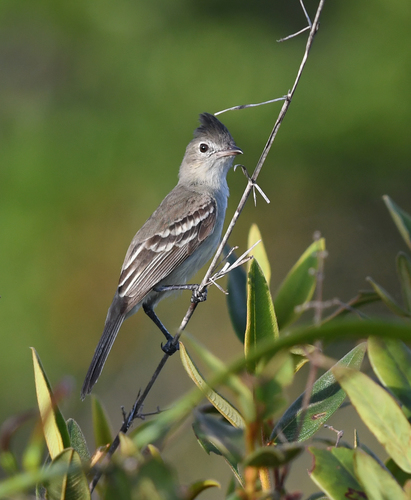
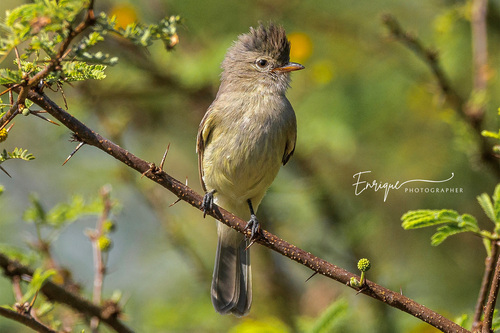
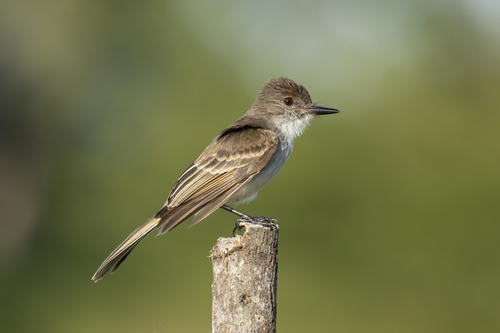
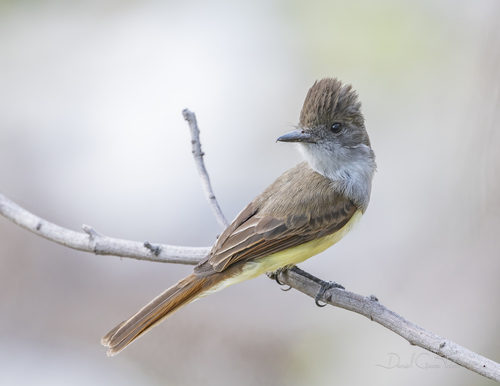
Myiarchus tuberculifer, commonly called the dusky-capped flycatcher, measures 16 to 18.5 cm (6.3 to 7.3 in) long and weighs 14 to 27 g (0.49 to 0.95 oz). The sexes have identical plumage. Adults of the nominate subspecies M. t. tuberculifer have a sooty brown crown and face, with crown feathers forming a slight crest. Their upperparts are mostly dark greenish olive-brown, with browner uppertail coverts. Their wings are mostly dusky, with thin dull white edges on the secondaries and thin buffy-white edges on the inner primaries. The greater and median wing coverts have buffy brown edges, and their tail is dark grayish brown. Their throat and breast are gray, while their belly and undertail coverts are yellow. Other subspecies differ from the nominate and one another in the following ways: M. t. olivascens has a blackish crown and pale gray face, grayish olive to olive green upperparts, rusty to ochre uppertail coverts, wing coloring matching the back with ochre, rufous, and yellowish to white edges on various feather groups, a fuscous tail with ochre feather edges, a pale gray throat and upper breast, and straw yellow lower breast and belly. M. t. lawrenceii has a dark grayish brown crown and sooty brown face, mostly olive upperparts with browner uppertail coverts, dusky grayish brown wings with cinnamon, cinnamon-brown, and cinnamon-rufous edges on various feather groups, a deep grayish brown tail with cinnamon-rufous edges on outer webs, gray throat and breast, and light yellow underparts with an olive tinge on the sides. M. t. querulous, M. t. platyrhynchus, M. t. manens, M. t. connectens, and M. t. littoralis differ only minimally from M. t. lawrenceii. M. t. nigricapillus has a very dark sepia or olive brown to sooty black crown and dark brown face, olive upperparts, rufous edges on wing coverts, cinnamon-rufous edges on flight and tail feathers, gray throat and breast, and bright yellow belly and undertail coverts. M. t. brunneiceps resembles the nominate subspecies. M. t. pallidus has a paler crown and lighter, less brown upperparts than the nominate. M. t. nigriceps has a black crown and is otherwise similar to the nominate. M. t. atriceps has a sooty black to blackish crown and is otherwise similar to the nominate. All subspecies have a dark brown iris, a black bill with a lighter base, and black legs and feet. Dusky-capped flycatcher subspecies have the following distribution: M. t. olivascens is found from southeastern Arizona and southwestern New Mexico south through Mexico to Oaxaca; it has also been recorded further north and west in Arizona, a few times in California, and a few times in western Texas. M. t. lawrenceii is found from Nuevo León in eastern Mexico south into Guatemala and El Salvador. M. t. querulous inhabits southwestern Mexico from southern Sinaloa south to Oaxaca, plus the Tres Marias Islands. M. t. platyrhynchus is found on Cozumel Island. M. t. manens ranges from eastern Tabasco in eastern Mexico south into northern Belize, including the Yucatán Peninsula. M. t. connectens occurs from western Belize and northern Guatemala south through Honduras to central Nicaragua. M. t. littoralis is found along the Pacific coast of Nicaragua into northwestern Costa Rica. M. t. nigricapillus inhabits extreme southeastern Nicaragua, most of Costa Rica, and western Panama including its offshore islands. M. t. brunneiceps ranges from the Panama Canal Zone into northwestern and western Colombia to Cauca and Huila departments. M. t. pallidus is found in northern and northeastern Colombia and western and northern Venezuela north of the Orinoco River. M. t. tuberculifer occurs on Trinidad; in central Colombia, eastern Ecuador, eastern Peru, and northern Bolivia east through Venezuela south of the Orinoco, the Guianas, and Amazonian Brazil, with a separate population in southeastern Brazil. M. t. nigriceps is found from southwestern Colombia south through most of western Ecuador. M. t. atriceps occurs on the east side of the Andes from southern Ecuador south through eastern Peru and Bolivia into northern Argentina. The dusky-capped flycatcher lives in a very wide variety of landscapes across its extremely large range. During the breeding season in Arizona and New Mexico, subspecies M. t. olivascens occurs in riparian areas with deciduous trees, pines, and live oak. In northern Mexico it also lives in riparian woodlands, pine-oak woodlands, tropical thorn scrub, and deciduous forest. In the non-breeding season it inhabits similar landscapes, and also semi-deciduous forest, and both humid and dry pine-oak forest, reaching elevations up to 2,250 m (7,400 ft). From eastern Mexico to Nicaragua, multiple subspecies inhabit tropical evergreen, semi-deciduous, and deciduous forest; cloudforest; coastal scrublands; swamp forest; thorn forest; both humid and semi-arid pine-oak forest; riparian zones in arid pine-oak forest and scrublands; and plantations. In this region, the species ranges in elevation from sea level to at least 2,950 m (9,700 ft). In Costa Rica and western Panama, it tends to favor somewhat open landscapes such as forest edges and openings, mature secondary forest, plantations, mangroves, and gardens, reaching about 1,800 m (5,900 ft) in elevation. In the Amazon Basin from Colombia south to Bolivia and east to the Atlantic, subspecies M. t. tuberculifer primarily lives in várzea and terra firme forest, plus the transitional forest between them. It also occurs in secondary forest, riparian forest, and plantations, ranging from sea level to 1,300 m (4,300 ft) in Brazil. It is mostly found below 1,500 m (4,900 ft) in Ecuador, below 1,200 m (3,900 ft) in Peru, and below 1,300 m (4,300 ft) in Venezuela. The primarily Andean subspecies M. t. atriceps inhabits subtropical and temperate zones between 700 and 3,400 m (2,300 and 11,200 ft), where it occurs in evergreen, semideciduous, and deciduous montane forest, and typically prefers the canopy and forest edges. Other subspecies found from Panama south through Colombia and western Ecuador and Peru live in tropical and subtropical evergreen and deciduous forest, riparian zones, secondary forest, and plantations. They also favor forest edges and openings, reaching 3,000 m (9,800 ft) in some areas, but only 1,800 m (5,900 ft) in Colombia and 2,500 m (8,200 ft) in Ecuador.