About Myiarchus panamensis Lawrence, 1860
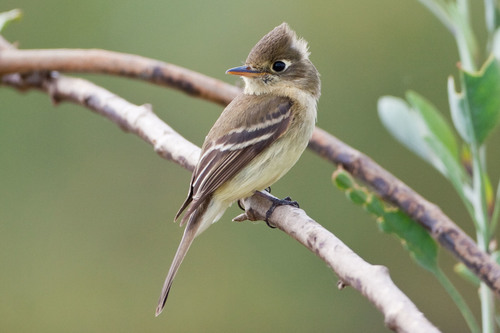
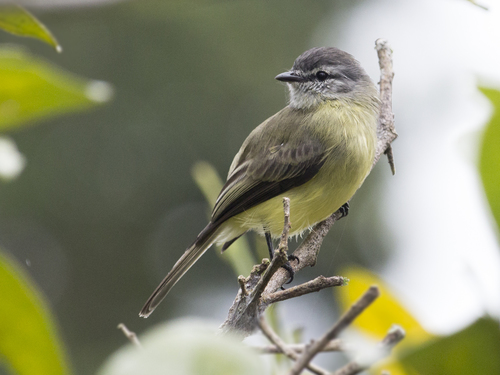
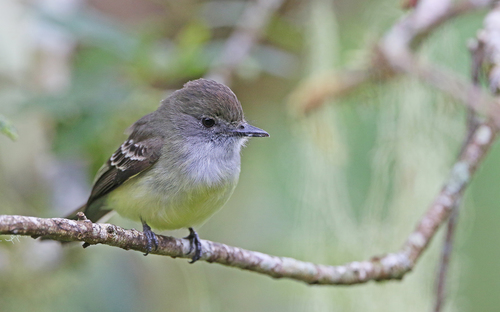
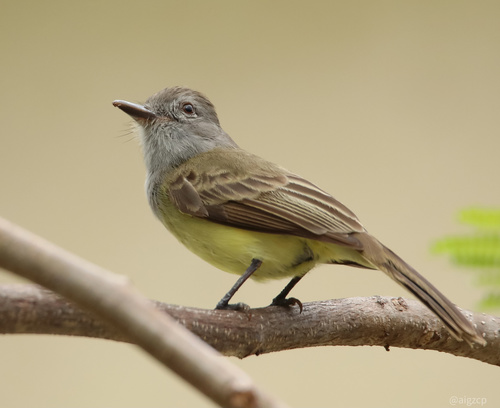
The Panama flycatcher (Myiarchus panamensis Lawrence, 1860) measures 19 to 20 cm (7.5 to 7.9 in) in length and weighs approximately 28 to 38.5 g (0.99 to 1.4 oz). Males and females have identical plumage. Adults of the nominate subspecies have grayish olive crowns and upperparts. The crown has a slight crest and is slightly darker at its center, creating a streaked appearance. The rest of the bird’s face is gray. Most of the wings are grayish olive, with pale whitish yellow outer webs on the tertials. The tail is brown, with slightly paler outer vanes on the outermost pair of feathers. The throat and breast are gray, while the belly and undertail coverts are yellow, with a greenish wash on the upper flanks. Subspecies M. p. actiosus has grayer upperparts and a paler belly than the nominate subspecies. Both subspecies have a dark iris, a dark bill that often has a paler base to the mandible, and dark legs and feet. Juveniles of both subspecies have rufous edges on their wing coverts and tail feathers. The species has two subspecies; M. p. actiosus is the more northerly of the two and has a much smaller range. It occurs along the Pacific coast of Costa Rica, from the Gulf of Nicoya south almost to the Osa Peninsula. The nominate subspecies ranges from extreme southwestern Costa Rica through Panama, along the Pacific slope and starting at Bocas del Toro Province on the Caribbean slope. It also lives on most of the islands off Panama’s Pacific coast. Its range continues into western Colombia, extending along the full length of the country’s Pacific slope southward and slightly into northwestern Ecuador. The range crosses northern Colombia into the Maracaibo Basin in northwestern Venezuela, and extends south within Colombia into the lower Cauca River valley and the upper Magdalena River valley. Subspecies M. p. actiosus only inhabits coastal mangroves. The nominate subspecies lives in a wide variety of landscapes: tropical deciduous forest, gallery forest, and secondary forest. It also occurs in mangroves, especially on the Pacific slope, and in more open habitats such as woodlands and pastures with scattered shrubs. Overall, the Panama flycatcher occurs at elevations from sea level up to 1,400 m (4,600 ft). It reaches only 800 m (2,600 ft) in Colombia and 150 m (500 ft) in Venezuela.