About Myiarchus nuttingi Ridgway, 1882
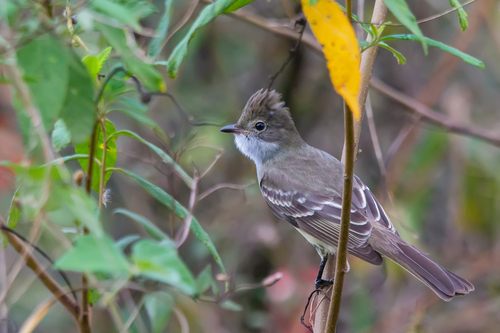
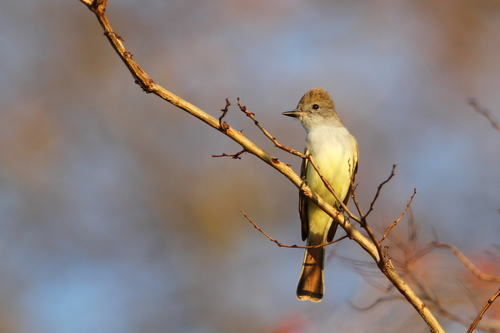
Nutting's flycatcher (Myiarchus nuttingi Ridgway, 1882) measures 18 to 19 cm (7.1 to 7.5 inches) long and weighs approximately 21 to 24 g (0.74 to 0.85 oz). Both sexes share identical plumage. Adults of the nominate subspecies have a drab gray-brown crown with a slight crest, while the rest of the face is a paler gray. Their upperparts are mostly drab gray-brown, with a rufescent tinge on the uppertail coverts. Their wings are browner than the upperparts, with rufous outer edges on the primaries, and grayish white outer edges on the secondaries and tertials. Pale tips on the wing's greater and median coverts form two distinct wing bars. The tail is mostly drab gray-brown, with thin rufous edges on all feathers except the outermost ones. The throat and breast are gray, and the belly and undertail coverts are yellow. The subspecies M. n. inquietus is larger than the other two subspecies, but otherwise matches the nominate subspecies in appearance. M. n. flavidor has a richer yellow belly than the other two subspecies. All subspecies have a dark iris, a dark bill, and dark legs and feet. Juveniles have significantly more rufous coloring on the tips of their wing coverts and central tail feathers. Three subspecies of Nutting's flycatcher have differing distributions. M. n. inquietus, the northernmost subspecies, occurs in western and central Mexico, ranging from Sonora south to Chiapas, and extending east into San Luis Potosí and Hidalgo. The nominate subspecies is found in the Mexican interior in Oaxaca and Chiapas, ranging south along the interior Pacific slope through Guatemala, El Salvador, Honduras, and Nicaragua into Guanacaste Province in northwestern Costa Rica. M. n. flavidor occurs more coastally on the Pacific slope, from Oaxaca and Chiapas south to western Nicaragua. Nutting's flycatcher inhabits forest and scrubland in tropical and lower subtropical zones, including tropical deciduous forest, gallery forest, and virgin and second-growth arid scrub. In northern Central America it also lives in thorn forest, and in Costa Rica it occurs in more humid forest than in areas further north. Its overall elevation range is from sea level up to 1,800 m (5,900 ft); in Costa Rica, it only reaches elevations of 1,200 m (3,900 ft).