About Myiagra vanikorensis (Quoy & Gaimard, 1830)
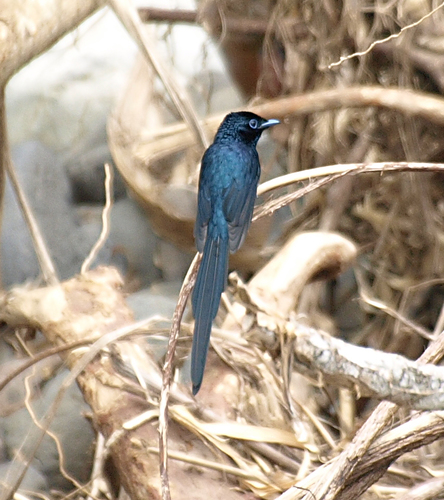
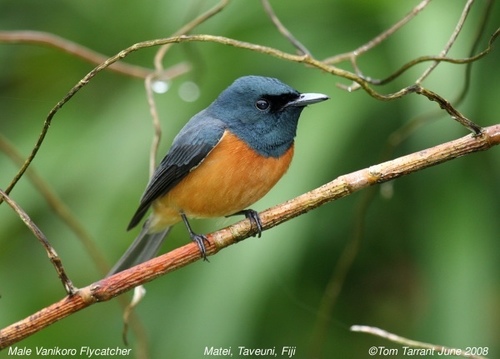
The Vanikoro flycatcher, Myiagra vanikorensis, is a small passerine bird, measuring 13 cm long and weighing approximately 13 g. It has a large, slightly hooked black bill and black legs. Plumage differs between males and females. Males have dark blue-black plumage across the head, throat, back, tail and wings, a pale red belly, and a white rump. Females follow a similar pattern but are paler overall, with orange instead of red on the belly, slate grey instead of dark blue, and orange from the belly extending up the throat to the bill. There is additional plumage variation across subspecies: the female of the dorsalis race from the northern Lau Group has a white throat, while the male of the kandavensis subspecies has much richer orange underparts. Juvenile Vanikoro flycatchers resemble females, but also have white scalloping on their wings. The Vanikoro flycatcher can live in a wide range of habitats. It naturally occurs in forest and forest edge habitats from sea level up to 1100 m, but it has also adapted to disturbed, human-altered habitats including gardens and cultivated areas, as long as some trees remain standing. This species is insectivorous, catching a variety of insects by sallying out from perches to snatch them mid-air or from the undersides of leaves. Beyond insects, Vanikoro flycatchers also eat lizards and small fruits. In undisturbed forest, individuals, pairs, or small groups forage in the canopy; in disturbed areas they use other spaces, foraging around buildings and are highly inquisitive. In Fiji, the Vanikoro flycatcher breeds from September to February. It builds a small cup-shaped nest from plant fibres, grass stems and roots. The outside of the nest is decorated with lichen and leaves, and it is lined with animal hair. The nest is placed high in a tree on a horizontal branch. Both sexes participate in nest construction, incubation, and chick rearing. Clutches contain 1 to 2 pinkish-white eggs marked with dark freckles. Vanikoro flycatchers will aggressively mob predators such as the Fiji goshawk and the local race of the peregrine falcon.