About Myiagra nana (Gould, 1870)
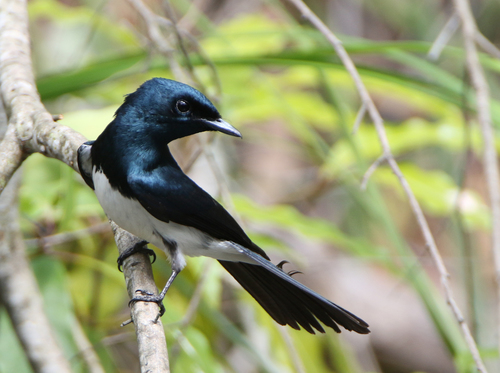
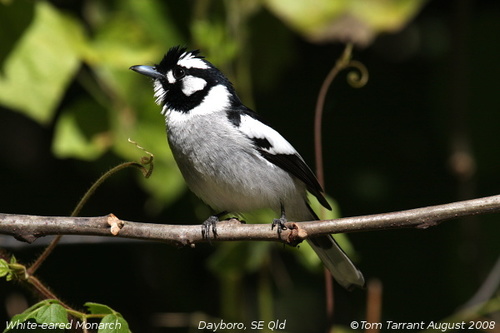
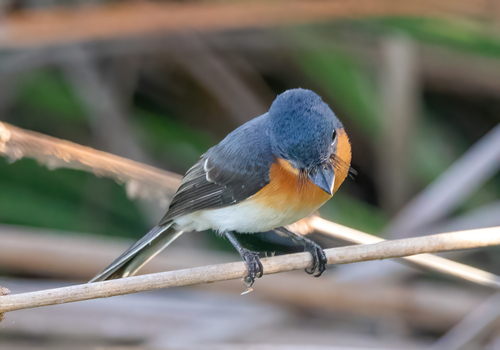
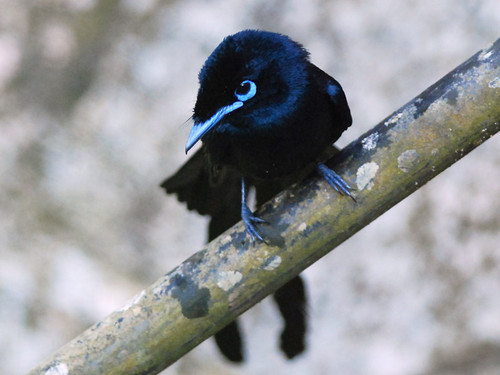
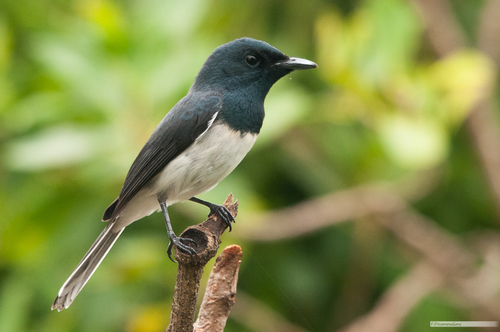
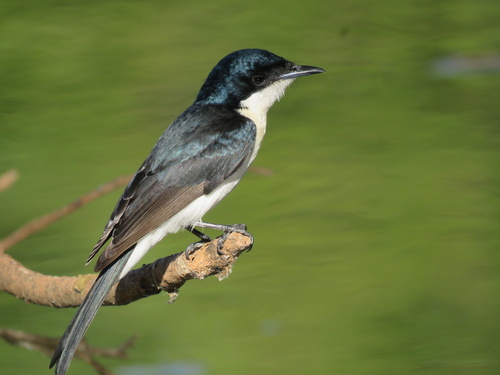
The paperbark flycatcher (Myiagra nana) is broadly similar in appearance to the closely related restless flycatcher (Myiagra inquieta). It has entirely black upperparts covering the crown, sides of the head, back, and body, which contrasts sharply with entirely white underparts running from the throat to the vent. It is distinctly smaller than the restless flycatcher, reaching only two-thirds of that species' weight, with no overlap in size between the two species. It also has a proportionately shorter, broader bill, as well as longer and stouter rictal bristles. While the back and crown of M. nana are the same glossy black, the restless flycatcher M. inquieta has a slightly paler, slate-grey back. The two species also differ in their vocalizations: M. nana almost never produces the distinctive 'scissors-grinding' call that is characteristic of M. inquieta.
This species is distributed across northern Australia and southern New Guinea. In northern Australia, its range stretches from the Kimberley region of Western Australia, across the Top End of the Northern Territory, to the Gulf Country and south-western Cape York Peninsula in north-west Queensland. There is also an established population on Saibai Island in the Torres Strait. In southern New Guinea, it occurs from Merauke eastward to the Bensbach River in the Middle Fly District. The paperbark flycatcher does not share overlapping distribution with the restless flycatcher. While their ranges adjoin one another in northern Queensland, there is no evidence of intergradation between the two species. In this zone of adjacent ranges, most restless flycatchers present are non-breeding migrants.
In Australia, the paperbark flycatcher lives in tropical eucalypt woodlands, paperbark woodlands, and dry riverine woodlands. In New Guinea, it is locally common along the lower reaches of the Bensbach River, and most often frequents scrub, partly submerged trees, and sedgeland that borders rivers on floodplains and savanna.