About Mycteroperca rubra (Bloch, 1793)
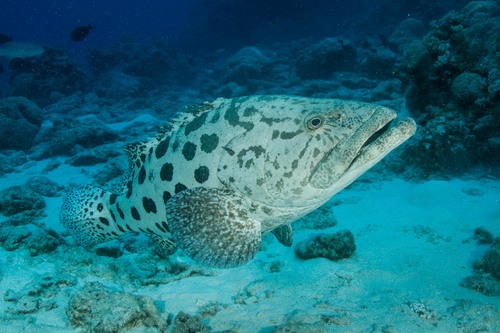
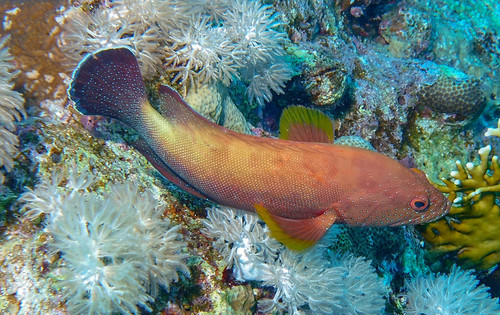
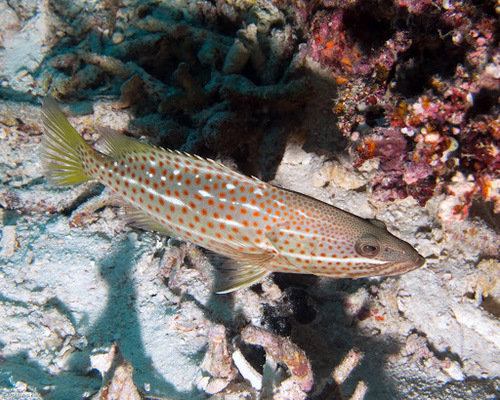
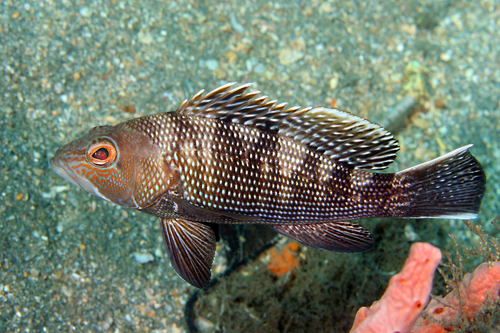
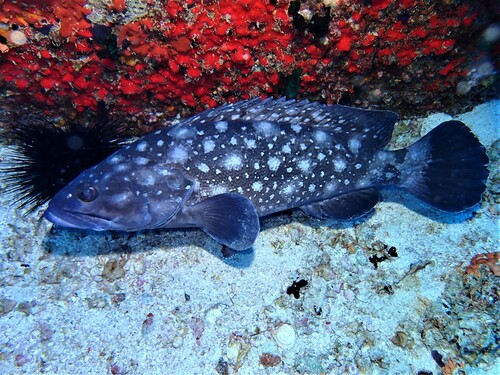
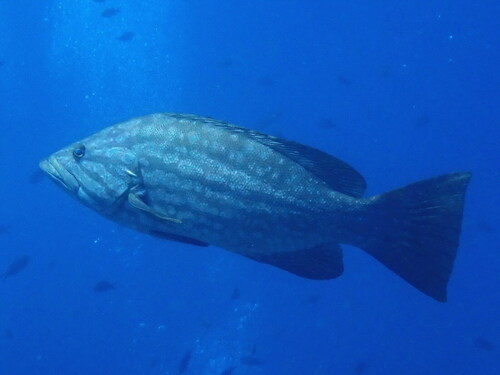
Mycteroperca rubra, commonly known as the mottled grouper, has an oblong, compressed body. Its body depth is less than the length of its head, and standard length measures 2.8 to 3.2 times body depth. The preopercle has a serrated margin, with enlarged serrations at its angle, where a rounded lobe sits below an incision in the margin. The dorsal fin has 11 spines and 15 to 17 soft rays, while the anal fin has 3 spines and 11 to 12 soft rays. The caudal fin is truncate in juveniles and subadults, but becomes concave in adults with a standard length over 50 centimetres (20 in).
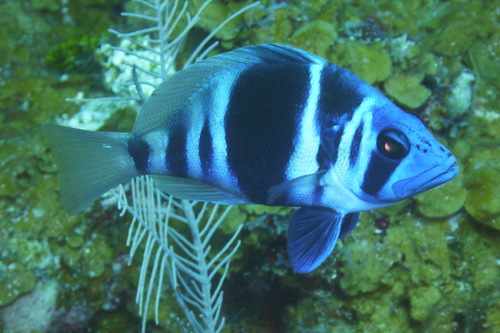
Mottled groupers are usually reddish brown, often mottled with black or pale grey spots, and have a black streak above the upper jaw. Juveniles have a black saddle blotch on the caudal peduncle. This species has a maximum published total length of 144 centimetres (57 in), with a more typical total length of 80 centimetres (31 in), and a maximum published weight of 49.7 kilograms (110 lb).
The mottled grouper is found in the eastern Atlantic Ocean and parts of the Mediterranean Sea. In the eastern Atlantic, it occurs from southern Portugal and Spain along the western African coast as far south as Angola. It was historically found in the southern Mediterranean from southern Spain and Morocco to Egypt and Israel, but has expanded its range northward to Provence in France and the Adriatic Sea. It is not found in the Black Sea. Records of this species from the Macaronesian Islands are actually misidentifications of the island grouper (Mycteroperca fusca), and records from Brazil are misidentifications of the comb grouper (Mycteroperca acutirostris).
The mottled grouper is a demersal species that lives on rocky reefs and adjacent sandy substrates down to depths of 200 metres (660 ft). It is typically more common at shallower depths between 1 and 30 metres (3.3 to 98.4 ft) in the eastern Mediterranean. It readily colonizes artificial reefs such as shipwrecks off the coast of Sicily. Juveniles are usually found in shallower inshore waters. It feeds on molluscs and small fishes.
This species is a protogynous hermaphrodite: individuals transition from female to male at 9 years of age, when they reach a total length of 53 centimetres (21 in). Females reach sexual maturity at a total length of approximately 27 to 32 centimetres (11 to 13 in), around 4 to 5 years of age. Spawning aggregations of the mottled grouper have been recorded off the coasts of Israel, Senegal, Turkey, and Corsica.