About Mycteroperca microlepis (Goode & Bean, 1879)
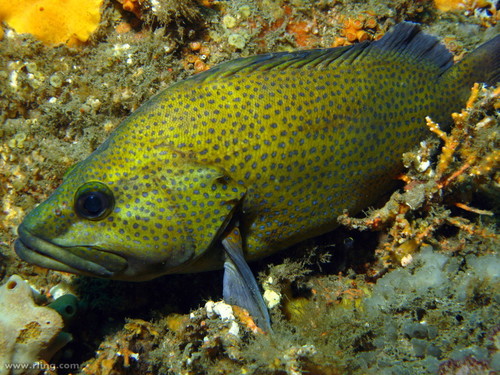
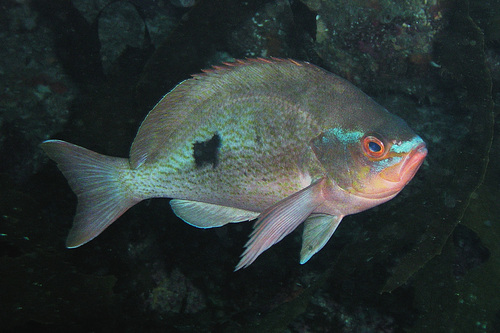
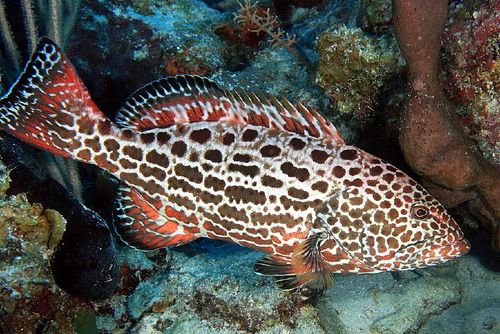
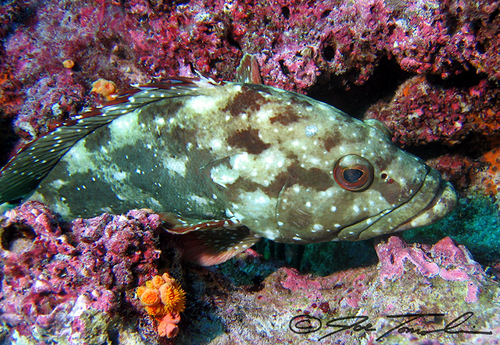
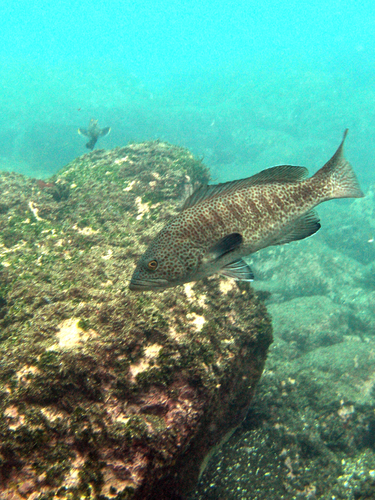
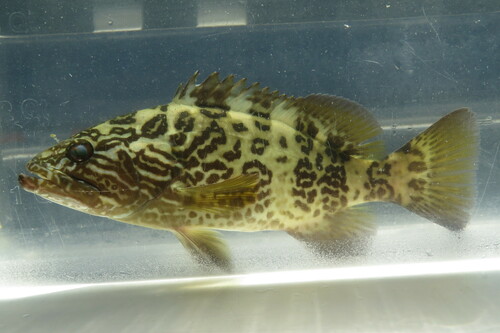
The gag grouper, Mycteroperca microlepis, has an oblong, robust body that is laterally compressed. Its body depth is normally less than the length of its head, and body depth is roughly equal at the origin of the dorsal fin and the origin of the anal fin. The fish's standard length is three to three and a half times its body depth. The dorsal profile of the head is convex, and the preopercle has a rounded lobe at its angle that bears enlarged serrations. The dorsal fin has 11 spines and 16 to 18 soft rays, while the anal fin has 3 spines and 10 to 12 soft rays. The membranes between the dorsal fin spines are notched, and the third and fourth spines are the longest. The caudal fin is square in shape. Adult females and juveniles are normally pale grey to brown-grey, marked with darker blotches and wavy lines that create a marbled appearance on the upper flanks and back. The pelvic, anal, and caudal fins have bluish-black margins. When at rest, this fish often takes on a camouflage pattern of 5 dark brown saddles separated by white bars running along the base of the dorsal fin. Large adult males are typically pale to medium grey, with an indistinct reticulated pattern under the dorsal fin. Their breast and belly are darker grey or black, and this same dark colour appears on the margins of the soft-rayed portion of the dorsal fin, the caudal fin, and the posterior margins of the pectoral and pelvic fins. There is also a "black-back" colour phase, where the rear of the body and all of the soft-rayed portions of the dorsal and anal fins are black. This species reaches a maximum total length of 145 centimetres (57 in), though 50 centimetres (20 in) is a more common length. The maximum published weight for the gag grouper is 36.5 kilograms (80 lb).
The gag grouper is found in the western Atlantic Ocean, where it has a disjunct distribution. The northern population occurs around Bermuda and along the eastern coast of the United States from North Carolina south to the Yucatan Peninsula of Mexico. It is largely absent from Cuba, with only one recorded vagrant individual. The southern population is found in southern Brazil, from Rio de Janeiro State to Santa Catarina State. Juveniles have been recorded as far north as Massachusetts.
Gag grouper have different habitat preferences at juvenile and adult life stages. Juveniles live in estuaries and seagrass beds, while adults live farther offshore over rocky substrates, at depths from 10 to 40 metres (33 to 131 ft), and have been recorded as deep as 152 metres (499 ft). Adults are occasionally recorded inshore over rocky or seagrass beds. It is one of the most common grouper species in the eastern Gulf of Mexico. It can live in both brackish and marine waters. Adults occur either as solitary fish or in groups of 5 to 50 individuals. When under stress, they produce thumping sounds by vibrating their swim bladder using muscular contractions. Adults are predators that feed on fishes (including smaller gag grouper), crabs, shrimps, and cephalopods, while smaller juveniles prey on crustaceans in shallow seagrass beds. The fish they eat are mostly herring, sea bream, jacks and pompanos, drums, and grey mullet.
This species is a protogynous hermaphrodite: all individuals start life as females. They reach sexual maturity between 5 and 6 years old, when they reach a total length of 67 to 75 centimetres (26 to 30 in). After spawning at least once, some individuals change sex to become males. In offshore waters between North Carolina and Florida, surveys between 1976 and 1982 found the sex ratio favoured females, with 84% of the population female, 15% male, and 1% in the process of changing sex. A later study found the proportion of males had decreased to around 5.5%, and fishing pressure targeting large males is the probable cause of this change. While sex change can occur as early as 5 years old, it more typically happens at 10 to 11 years old, when the fish reaches a total length of 95 to 100 centimetres (37 to 39 in).
In Atlantic coastal waters between North Carolina and Florida, sexually mature gag grouper make annual migrations to offshore spawning grounds in late winter, at depths of 70 metres (230 ft). The spawning season in this region runs from December through May, peaking in late March and early April. In the eastern Gulf of Mexico, the spawning season runs from late December through April, peaking in February and April. After spawning, females move into shallower water less than 30 metres (98 ft) deep, while males prefer water 50 to 90 metres (160 to 300 ft) deep. The maximum recorded age for this species is 31 years.