About Mycteria leucocephala (Pennant, 1769)
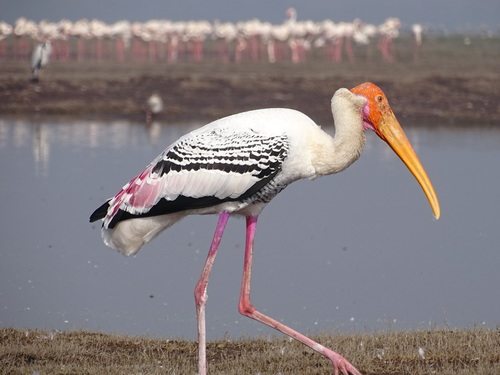
This species, the painted stork (Mycteria leucocephala), is a large stork with a heavy yellow beak that has a down-curved tip, giving it a resemblance to an ibis. Adult painted storks have a bare, orange or reddish head. Their long tertials are tipped with bright pink, and when the bird is at rest these feathers extend over its back and rump. Adults have a distinctive black breast band marked with white scaly patterns; this band extends into the under-wing coverts, and the white tips of the black coverts create the appearance of white stripes across the under-wing lining. The rest of an adult's body is whitish, while the primaries and secondaries are black with a greenish gloss. Their legs range from yellowish to red, but often appear white because the species habitually defecates on its legs (a behaviour called urohidrosis), especially when at rest. The short tail is black with a green gloss. This is a medium-sized stork, standing 93–102 cm (36.5–40 in) tall, with a wingspan of 150–160 cm (59–63 in) and a body weight of 2–3.5 kg (4.4–7.7 lb). Males and females have similar appearance, but paired males are usually larger than females. Downy young storks are mostly whitish, with grey bills and blackish facial skin. Juveniles develop brownish plumage, and like most other storks, they reach breeding condition after two to three years. Like all storks, painted storks fly with their necks outstretched. They often use late morning thermals to soar while searching for foraging areas. Like other storks, they are mostly silent, but will clatter their bills at the nest and may produce harsh croaking or low moaning sounds at the nest. The painted stork is widely distributed across the plains of Asia. It occurs south of the Himalayan ranges, and is rare west of the Indus River system, extending eastward into Southeast Asia. It is not found in very dry or desert regions, dense forests, or higher hill regions. It was rare across most of Kerala, and only expanded into this region in the 1990s. Painted storks prefer freshwater wetlands year-round, but will also use irrigation canals and crop fields, especially flooded rice fields during the monsoon. Most populations are resident, but the species makes seasonal movements. Young birds may disperse long distances from their breeding sites; this is demonstrated by a juvenile ringed at a nest in Keoladeo National Park that was recovered 800 kilometres away at Chilka in eastern India. Breeding always occurs on large trees, usually in areas where nesting trees are protected over long periods. These protected areas can include wetland reserves, along community-managed village ponds and lakes, inside villages where nesting birds receive protection (such as Kokrebellur), protected tree patches in urban locations like zoos, and on islands in urban wetlands. Painted storks feed in groups in shallow wetlands, crop fields, and irrigation canals. A study at Keoladeo National Park found that maximum prey capture success occurs at a water depth of 7 cm. They feed mainly on small fish, which they detect by touch while slowly sweeping their half-open bill from side to side while it is held submerged. They walk slowly and disturb water with their feet to flush out fish. They also eat frogs and occasionally snakes. They forage mainly during the day, but may forage late into the evening or even at night under unusual conditions. After feeding, they may stand still on the shore for long periods. Painted storks in the Delhi region have been observed eating fish, while those at Kokrebellur in southern India fed their nestlings frogs, crabs, large insects, and grasshoppers. In agricultural landscapes, flock sizes are mostly small, with fewer than 5 birds, but can reach more than 50 birds. In these landscapes, flock size does not change much between seasons, but population density is much higher in winter after the year's chicks have fledged from nests. Painted storks breed on trees either in mixed colonies with other water birds, or in single-species colonies. The breeding season begins in the winter months shortly after the monsoons. In northern India, the breeding season starts in mid-August, while in southern India nest initiation begins around October and continues through February, sometimes even to April. A detailed study in Bengaluru city found storks built nests between early February and mid-March, with all observed nests producing fledglings by mid-May. There is considerable variation in the start of breeding across sites: breeding begins around January or February at Kokrebellur and Edurupattu, and around October or November at Telineelapuram, Kundakulam, and Tirunelveli. A typical clutch holds 1 to 5 eggs, and earlier breeding pairs tend to have larger clutches. The incubation period is about one month, and the fledging period is almost two months. Chicks are occasionally preyed on by migrant Aquila eagles, Pallas's fish eagle, House Crows, and Black Kites. During mid-day heat, adult storks stand over the nest with their wings outstretched to shade the chicks. They defecate on their highly vascularized legs to cool themselves, this behaviour called urohidrosis becomes more frequent as ambient temperature rises. To feed chicks, adults regurgitate caught fish, which are typically smaller than 20 cm (7.9 in) long. When threatened, young chicks disgorge food and feign death by crumpling to the nest floor. The daily food requirement for chicks has been estimated at 500–600 grams (18–21 oz), made up of around 9 fish fed in two separate sessions. Daily nest survival is higher for nests started early in the monsoon season, lower when temperatures decrease, and higher in larger colonies. The bare red skin on the head, which develops when breeding maturity is reached, forms after feathers are lost and lipids are deposited under the skin. Captive painted storks have been known to live as long as 28 years. Birds hand-raised from chicks can be tame and docile, and even respond to their names when called. Two parasite species have been described from this stork: the bird louse Ardeicola tantali, described from a specimen collected from this species, and the subcutaneous mite Neottialges kutzeri, from the family Hypoderidae.