About Mycteria ibis (Linnaeus, 1766)
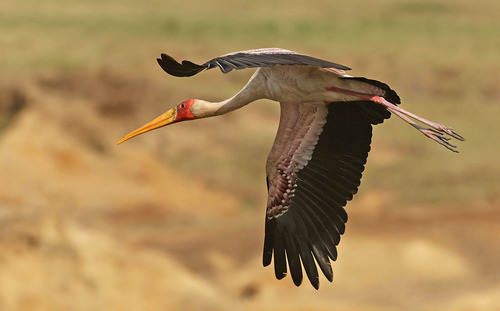
This medium-sized stork species, Mycteria ibis, stands 90–105 cm (35–41 in) tall. Its body is white, with a short black tail that shows green and purple gloss when freshly moulted. The bill is deep yellow, slightly curved downward at the tip, and has a rounder cross-section than stork species outside the Mycteria genus. Feathers cover the head and neck down to just behind the eyes, while the face and forehead are covered in deep red bare skin. Both sexes look similar, but the male is larger, with a slightly longer, heavier bill. Males weigh approximately 2.3 kg (5.1 lb) on average, and females weigh approximately 1.9 kg (4.2 lb) on average. The species' colouration becomes more vivid during the breeding season: in breeding season, the upperwings and back gain pink plumage, the normally brown legs turn bright pink, the bill becomes a deeper yellow, and the face becomes a deeper red. Juveniles are greyish-brown, with a dull, partially bare orange face and a dull yellowish bill. Their legs and feet are brown, and all over their body feathers are blackish-brown. At the fledging stage, salmon-pink colouration begins to develop on the underwings. After around one year, their plumage turns greyish-white, the flight feathers on the tail and wings become black, and eventually the pink colouration typical of adult plumage appears. When walking on the ground in shallow water, these storks use a high-stepped stalking gait, with a recorded walking rate of approximately 70 steps per minute. When flying, they alternate between flapping and gliding, with an average flap speed of 177–205 beats per minute. They usually only flap for short flights; for travel between breeding colonies, roosts, and feeding sites, they often soar and glide over several kilometres. By alternately soaring on thermals and gliding, they can cover large distances without expending much energy. When descending from high altitudes, this stork has been observed diving deeply at high speed and flipping repeatedly from side to side, performing impressive aerobatics, and it even appears to enjoy these aerial stunts. The species is generally non-vocal, but will produce hissing falsetto screams during social displays in the breeding season. At breeding colonies, these storks also perform bill clattering and make an audible 'woofing' sound with their wing beats. Nestlings give a loud, continuous, monotonous braying call to beg adult parents for food. The yellow-billed stork occurs primarily in Eastern Africa, but is widely distributed across an area that extends from Senegal and Somalia down to South Africa, and also lives in some regions of western Madagascar. During an observation of a mixed-species bird colony on Kenya's Tana River, this species was found to be the most common, with 2000 individuals counted at once. It is also the dominant species in large breeding colonies at Lake Manyara and the Ihefu wetlands that border the Ripera River in Tanzania. This species generally does not migrate long distances, at least not outside its breeding range, but it usually makes short migratory movements shaped by rainfall. It makes local movements in Kenya, and has been recorded migrating from North to South Sudan with the rainy season. It may also migrate regularly to and from South Africa. However, little is actually known about this bird's overall migratory movements. Because of the observed variation in migratory patterns across Africa, the yellow-billed stork is described as a facultative nomad. It generally migrates to leave areas where water or rainfall conditions are not favourable for feeding on prey. Some populations travel considerable distances between feeding or breeding sites, usually using thermals to soar and glide. Other local populations are sedentary, remaining in their habitats year-round. Its preferred habitats are wetlands, shallow lakes, and mudflats, usually 10–40 cm deep. It usually avoids the heavily forested regions of central Africa, and also avoids flooded regions and large deep bodies of water, because feeding conditions there are not suitable for its characteristic grope and stir feeding method. This species breeds especially in Kenya and Tanzania. While it is known to breed in Uganda, no breeding sites have been recorded there. It has also been found breeding in Malakol, Sudan, and often breeds inside walled cities in West Africa from Gambia down to northern Nigeria. Additional breeding sites include Zululand in South Africa and northern Botswana; breeding sites are rarer below northern Botswana and Zimbabwe, even though that area is well-watered. There is no direct evidence of current breeding activity in Madagascar, but young flightless birds have been observed near Lake Kinkony during October.