About Mycteria cinerea (Raffles, 1822)
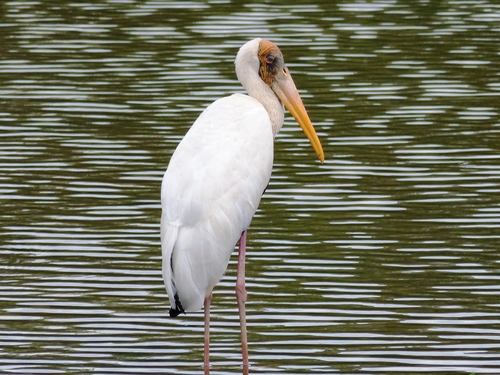
The milky stork (Mycteria cinerea) is a stork species that lives mainly in mangroves across Southeast Asia, and is native to Cambodia, Vietnam, Malaysia, and Indonesia. It is currently classified in the genus Mycteria. It stands 91–97 cm (36–38 in) tall, has a wingspan of 43.5–50 cm (17.1–19.7 in), and a tail that measures around 14.5–17 cm (5.7–6.7 in). Most of its plumage is white, with only a small number of feathers on the wings and tail being different in colour. Since the 1980s, the global milky stork population has fallen from 5,000 to 2,000 individuals, driven by habitat destruction, overfishing, and illegal smuggling of chicks. It is listed as Endangered on the IUCN Red List.
The milky stork's range is limited to Southeast Asia, where it is widespread but occurs in scattered, isolated populations. It can be found in Sumatra (which holds its largest global population), Java, Sulawesi, eastern Malaysia, Cambodia, southern Vietnam (where it likely largely recolonized after the 1963–1975 war), Bali, Sumbawa, Lombok, and Buton. Historically, the species lived in southern Thailand, but it is now very likely extinct there. A well-preserved adult male milky stork specimen collected in 1935 from Setul in Peninsular Thailand was later found in the collections of the Zoological Reference Collection at the National University of Singapore, confirming the species was formerly resident in this area. This specimen is the first and likely last milky stork ever reported from Thailand, though the species may still occasionally visit Thailand as a vagrant. It also occurs as a vagrant in other locations such as Bali and Sumbawa, and is a resident species on Sumatra, Java, and Sulawesi, all of which are part of Indonesia. The milky stork was first recorded on Sulawesi in 1977, when a group of five apparently resident individuals was sighted there. The island of Madura may also host an important population, after 170 individuals were sighted there in 1996.
In the past, the milky stork had a much larger range across Southeast Asia. For example, it was once widespread along the coasts of the Malaysian Peninsula, but is now restricted only to Matang Mangrove Forest in Perak. Throughout its range, the milky stork is mainly a lowland coastal species that lives in mangroves, freshwater swamps, peat swamps, and estuaries. However, all confirmed breeding records come from mangroves adjacent to feeding grounds. It forages on tidal mudflats, in shallow saline or freshwater pools, freshwater marshes, fishponds, rice fields, and backswamps along river floodplains up to 15 km from the coast. To breed, the milky stork requires extensive undisturbed mangrove (and possibly also riverine or dryland) forest with tall prominent trees, plus shallow pools inside the forest where juveniles can forage. The tall trees are also used for resting, and need to have enough clear space on individual branches for the storks to take off. Where suitable natural trees are not available, human-made alternatives such as cart wheels mounted on poles have been suggested as an option. In Peninsular Malaysia, the milky stork lives more exclusively in marine habitats than the closely related painted stork, which is also in the genus Mycteria. The ranges of the two species overlap in the marshy plains of Cambodia, where they likely use the same habitats.
The milky stork has a varied diet. In Malaysia, the diet mainly consists of 10–23 cm long mudskippers from the genera Periophthalmus and the family Gobiidae; in South Sumatra, catfish of the genus Arius may be the main dietary component. Other prey recorded in South Sumatra includes milkfish, giant mudskipper (Periophthalmodon schlosseri), mullet species from genera Moolgards and Chelon, eel catfish (Plotosus canius), fourfinger threadfin (Eleutheronema tetradactylum), and Chinese silver pomfret (Pampus chinesis). The stork also eats snakes and frogs, especially to feed to its young. Parent storks feed nestlings large fishes, eels, and mudskippers up to 20 cm long. In Sumatra, the elongate mudskipper (Pseudapocryptes elongates) was the most common prey found in nests. Other prey found in nests includes the Indian prawn (Fenneropenaeus indicus) and one species of clupeid fish (Thryssa dussumieri).
Milky stork chicks eat very actively. Small chicks under two weeks old may be fed by a parent up to four times in two hours, while older chicks are fed less often. Because feeding starts before all chicks have hatched, the youngest and smallest chicks are at a competitive disadvantage and often die of starvation. This outcome is more common because parent storks do not appear to split food evenly among all chicks in a brood. When temperatures are high, adult storks sometimes carry water back to the nest and drip it from their bills over the nestlings to cool them down and provide drinking water.
Milky storks also feed on farmed commercial shrimp. Active shrimp ponds typically operate for three months before they are drained. When the water level drops, any remaining shrimp are left exposed on the pond bottom, and milky storks and other wading birds come to feed on these leftover shrimp. This feeding opportunity may become more common as land-based aquaculture expands in Kuala Gula. In Java, milky storks have also been recorded feeding at fishponds, particularly after the dry season when receding waters leave open expanses of mud that are well-suited for their foraging. However, these human-made environments generally do not support successful breeding. The milky stork's estimated daily food intake is 630 g wet weight, which can be obtained within two hours when foraging at maximum intensity.
Several different feeding methods have been recorded for this stork. Like other species in the genus Mycteria, the milky stork finds and catches prey mostly by sense of touch, usually through bill groping or direct bill probing. Because it finds food primarily through touch, foraging is most efficient when prey concentrations are high. In the groping method, the stork walks slowly through shallow water with its partially open bill submerged around three-quarters of the way into the water. When prey touches the groping bill, the stork rapidly closes its mandibles, lifts its head, tosses the prey a few times, then swallows it whole. After swallowing a large fish, the stork may rest for up to one minute before starting to forage again. Alternatively, the stork may stand still at the water's edge with its half-open bill held steadily submerged in moving water, so that water flows through its mandibles. The milky stork also sometimes sweeps its bill in a side-to-side arc through the water while standing or walking, until it touches a prey item.
Another common tactile feeding method for this stork is direct probing of its bill into deep holes in the mud. With partially open mandibles, the bird inserts its bill into the mud then partially withdraws it, spending 5–32 seconds per hole. The bill is usually inserted three-quarters of its length into the mud, but sometimes it is inserted fully, or even up to the bird's eyes. The milky stork also uses prey herding methods common to other Mycteria species. One of these is foot stirring: the stork stands on one leg and disturbs the river bed with the opposite foot, which can drive aquatic prey out of hiding places the stork cannot reach. When prey density is high, milky storks forage in flocks and cooperatively drive fish into shallow water towards their half-open bills, a behaviour that has been observed in Java.
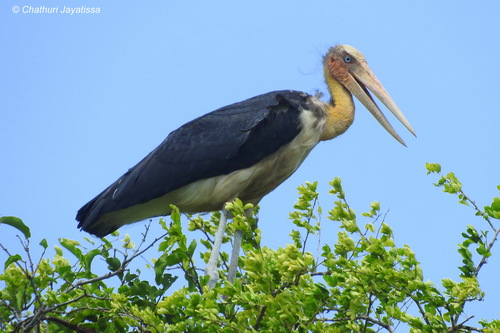
Milky storks often feed in groups alongside other wading bird species such as the lesser adjutant and egrets. The stork occasionally finds aquatic prey through direct visual search. During and after the local rainy season, which runs from November to March, large numbers of milky storks forage in flooded rice fields. The lower numbers of individuals seen on the coast during this time likely reflects the more favourable feeding conditions further inland. Milky storks have been regularly sighted along the Batang Hari River 50 km from the coast. During the breeding season, juveniles typically forage close to the breeding colony in shallow mangrove pools that have high fish densities.