About Mycteria americana Linnaeus, 1758
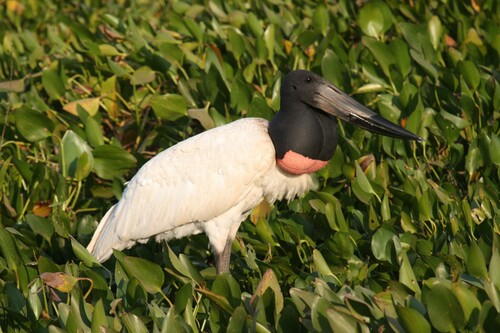
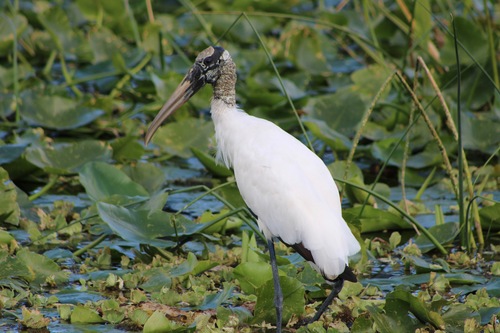
Mycteria americana Linnaeus, 1758, commonly called the wood stork, has the following physical description. Adult wood storks are large birds, standing 83 to 115 cm (33–45 in) tall with a wingspan of 140 to 180 cm (55–71 in). Males typically weigh 2.5 to 3.3 kg (5.5–7.3 lb), with an average weight of 2.7 kg (6.0 lb); females weigh 2.0 to 2.8 kg (4.4–6.2 lb), with an average weight of 2.42 kg (5.3 lb). An alternative estimate puts the species' average weight at 2.64 kg (5.8 lb). Adult wood storks have bare dark grey scaly skin on their head and neck. They have a long, black, downward-curved bill that is very wide at the base. Most of their plumage is white, while the primary flight feathers, secondary flight feathers, and tail are black with greenish and purplish iridescence. Their legs and feet are dark, and their normally pink or beige toes turn pink during the breeding season. The sexes have similar physical characteristics. Newly hatched wood stork chicks have a sparse covering of grey down (called protoptiles), which is replaced by dense, wooly white down (called mesoptiles) after approximately 10 days. Chicks grow quickly, reaching about half the height of adults within three to four weeks. By the sixth and seventh weeks after hatching, the plumage on their head and neck turns smoky grey. When they are fully fledged, they closely resemble adult wood storks, and only differ from adults by having a feathered head and a yellow bill.
The wood stork's current range covers the southeastern United States, Mexico, Central America, Cuba, and South America. In the United States, small breeding populations live in Florida, Georgia, and the Carolinas. After breeding, US wood storks can be found as far west as Alabama and Mississippi. In Mexico, non-breeding wood storks occur along both the Pacific and Atlantic coasts, while breeding colonies are only found on the Pacific coast. Most records of wood stork breeding colonies in western Mexico are more than 35 years old, but recent sources have confirmed active nesting colonies in the southwestern Mexican states of Oaxaca and Colima. Cuba holds the only two known wood stork breeding sites in the Caribbean; both colonies are located in major wetlands: Zapata Swamp and the Sabana-Camaguey Archipelago. Outside of Cuba, wood stork sightings are rare in the Caribbean, as the species was extirpated from Hispaniola and only occurs as a vagrant on other Caribbean islands. In South America, the wood stork's range extends south to northern Argentina. Most breeding colonies in Brazil are concentrated in the Pantanal wetland and the northern coastal region. After breeding, birds that nest in west-central Brazil often disperse to southern Brazil and northern Argentina. The wood stork can adapt to a variety of tropical and subtropical wetland habitats with fluctuating water levels, which trigger the species to breed. It nests in trees that stand over water or are surrounded by water. In freshwater habitats in the US, it primarily nests in forests dominated by trees of the genus Taxodium. In estuaries, it generally nests on trees in mangrove forests. For feeding, wood storks use freshwater marshes in habitats with abundant Taxodium trees, while they use brackish water in areas with mangrove forests. Areas with more lakes draw wood storks to feed on the edges of lakes, streams, and rivers.