About Mycosarcoma maydis (DC.) Bref.
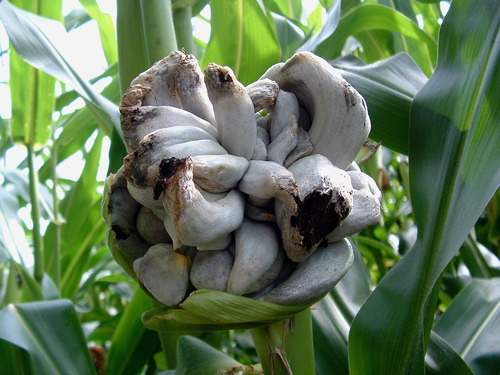
This species, with the scientific name Mycosarcoma maydis (DC.) Bref., is a fungus that infects all parts of its host corn plant by invading the plant's ovaries. Infection causes corn kernels to swell into tumor-like galls that have mushroom-like tissues, texture, and developmental pattern. These galls can reach 4 to 5 inches in diameter, and are composed of the infected plant's hypertrophied cells, along with fungal threads and blue-black spores. The dark spores give the infected corn cob a burned, scorched appearance. When grown in laboratory conditions on very simple media, M. maydis grows similarly to baker's yeast, forming single cells called sporidia that multiply by budding off daughter cells. When two compatible sporidia meet on the plant surface, they switch to a different growth mode. First, they produce either one pheromone and one corresponding type of pheromone receptor, determined by their mating type a or b, which is controlled by alleles at two unlinked mating loci. If this signaling is successful, they grow conjugation tubes to locate each other, then fuse and form a hypha to enter the corn plant. Hyphae growing inside the plant are dikaryotic, meaning each hyphal compartment holds two haploid nuclei. Unlike sporidia, the dikaryotic phase of M. maydis only occurs during successful infection of a corn plant, and cannot be maintained in laboratory settings. Mature tumors release spores that are dispersed by rain and wind. Under appropriate conditions, a metabasidium forms where meiosis occurs. Resulting haploid nuclei move into elongated single cells, which detach from the metabasidium to become sporidia, completing the fungus's life cycle. While not all conditions that favor M. maydis growth are known, specific abiotic and biotic factors promote the development of this corn smut. Hot, dry weather during pollination followed by a heavy rainy season increases the fungus's pathogenicity. Excess manure, and therefore extra nitrogen, in soil also increases pathogenicity. These abiotic factors increase both infectivity and disease spread. High winds and heavy rain further increase disease spread by making spore transmission easier. Key biotic factors are tied to human interaction with corn. If corn debris is not cleared after harvest, spores can overwinter in corn fragments and infect new crops the following season. Human-caused wounds to corn from shears or other tools also give M. maydis easier access to enter the plant. Fungal proliferation inside the host plant causes disease symptoms including chlorosis, anthocyanin formation, reduced growth, and the development of tumors that hold developing teliospores. These teliospores allow the pathogen to overwinter in soil to survive to the next growing season. Corn plants have evolved effective defense systems against pathogenic microbes. A rapid defensive reaction after pathogen attack is the oxidative burst, which produces reactive oxygen species at the site of attempted invasion. As a pathogen, M. maydis responds with an oxidative stress response regulated by the gene YAP1. This response protects the fungus from the host's attack and is required for the pathogen's virulence. M. maydis also has a well-characterized recombinational DNA repair system. This system includes a Rad51 homolog that has a very similar sequence and size to mammalian Rad51, plus the protein Rec2 (more distantly related to Rad51) and Brh2, which is a streamlined version of the mammalian Breast Cancer 2 (BRCA2) protein. Inactivation of any of these proteins increases M. maydis sensitivity to DNA damaging agents, causes deficient mitotic recombination, increases mutation frequency, and stops meiosis from completing. These observations suggest that recombinational repair during mitosis and meiosis in M. maydis helps the pathogen survive DNA damage caused by the host's oxidative defensive response to infection, as well as damage from other DNA damaging agents. M. maydis infection (corn smut) feeds on corn plants and reduces crop yield. Infected crops are often destroyed, though some farmers use them to make silage. However, immature infected galls are edible, and are highly valued as a delicacy in Mexico, where it is known as huitlacoche and sold for a significantly higher price than uninfected corn. Consumption of corn smut in Mexico originates directly from Aztec cuisine. For culinary use, galls are harvested while still immature; fully mature galls are dry and almost completely filled with spores. Immature galls are harvested 2 to 3 weeks after an ear of corn becomes infected, when they still retain moisture. When cooked, their flavor is described as mushroom-like, sweet, savory, woody, and earthy. Identified flavor compounds include sotolon, vanillin, and the sugar glucose. Huitlacoche is a source of the essential amino acid lysine, which the human body requires but cannot synthesize on its own. It also contains levels of beta-glucans similar to most edible fungi, and protein content equal or superior to most edible fungi. Corn smut has struggled to gain acceptance in American and European diets, as most farmers view it as a crop blight, despite efforts from governments and high-profile chefs to introduce it into food products. In the mid-1990s, due to demand from high-end restaurants, the United States Department of Agriculture (USDA) allowed farms in Pennsylvania and Florida to intentionally infect corn with huitlacoche. This limited approval is notable because the USDA had previously spent considerable time and money working to eradicate corn smut in the United States. In 1989, the James Beard Foundation held a prominent huitlacoche dinner prepared by Josefina Howard, chef at the Rosa Mexicano restaurant. This event attempted to encourage American consumption by renaming the ingredient "Mexican truffle", and it is often compared to truffles in food articles covering its taste and texture. Native American tribes in North America also ate corn smut. The Hidatsa tribe of North Dakota's practice of preparing and eating corn smut is described in detail in Buffalo Bird Woman's Garden. Native Americans of the American Southwest, including the Zuni people, have used corn smut to attempt to induce labor. It has medicinal effects similar to ergot, but weaker, due to the presence of the chemical ustilagine.