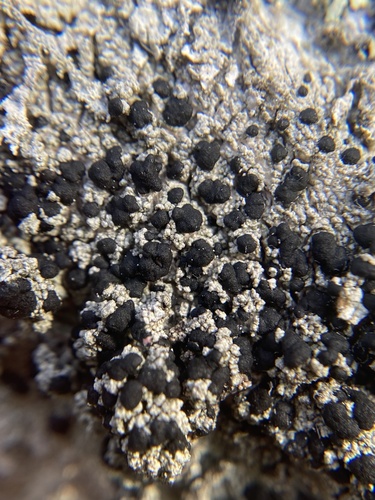
About Mycoblastus sanguinarius (L.) Norman
Mycoblastus sanguinarius (L.) Norman has a thallus that ranges in color from pale to dark grey. The thallus is often very irregular, thick, and has a coarse, wart-like (verrucose or papillose-warted) texture, which gives it a marbled appearance. It can be continuous or somewhat cracked, and a pale to dark grey prothallus (the initial growth stage) is sometimes present. Soralia, which are propagules for asexual reproduction, are rare. When they do form, they are rounded, scattered, usually few in number, and match or are paler than the thallus color. These soralia are convex and have an efflorescent, or powdery, appearance. Apothecia, the species' sexual reproductive structures, are usually frequent. They measure between 0.5 and 1.7 mm in diameter, and occasionally reach up to 3.0 mm across. They are black, become convex or hemispherical as they mature, and can be sessile (sitting directly on the thallus) or slightly constricted at the base. These apothecia develop on a bright carmine-red thalline cushion that becomes visible when the thallus is damaged or worn. The asci (spore-producing cells) typically contain 1 to 3 spores. The ascospores are cylindrical with rounded ends, measuring 70–100 μm in length and 35–45 μm in width, with a thick wall around 6–7 μm thick. Mycoblastus sanguinarius also commonly has pycnidia, small asexual reproductive structures. These pycnidia are 40–50 μm in diameter, have dark green walls, and produce bacilliform (rod-shaped) conidia measuring 6–9 μm in length and about 1 μm in width. In chemical spot tests, the thallus cortex shows reactions of C–, K+ (yellow), and Pd+ (yellow), while the medulla reacts K+ (red) in parts and UV–. These reactions confirm the presence of chemical compounds including atranorin, chloratranorin, rhodocladonic acid, and caperatic acid. Soralia do not react to Pd. Beneath the apothecia, the tissue and hypothecium are carmine to blood-red, react K+ (bright red), and the pigment diffuses into the testing solution. Mycoblastus sanguinarius grows in a variety of habitats, primarily as an epiphyte on tree bark in cool, moist environments. It is found in temperate forests across North America, Europe, and Asia. This lichen is particularly abundant in boreal and montane forests, where it often grows on the bark of coniferous trees such as spruce and fir. The species is also known to grow on decaying wood, and less frequently on mossy rock surfaces.

