About Mycenastrum corium (Guers.) Desv.
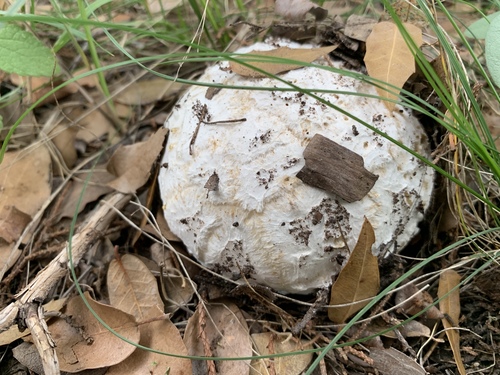
Mycenastrum corium (Guers.) Desv. is a species of puffball fungus. When young, its internal gleba tissue is white, with a cheesy appearance and consistency. As the puffball matures, it goes through a lytic process that involves water loss. The gleba changes color first to olivaceous, then to olive-brown, and finally becomes dark olive once dry, and develops a characteristic pungent smell. Mature fruit bodies typically reach 6–15 cm (2–6 in) in diameter, though extreme sizes as small as 3 cm (1.2 in) and as large as 27 cm (11 in) have been recorded. Fruit body shapes range from roughly spherical to obovate (egg-shaped) or pyriform (pear-shaped), and are sometimes plicate (crumpled, wrinkled) around a somewhat fibrous, persistent tuft of mycelium. Young puffballs are initially covered with a thick, felted, whitish outer layer called the exoperidium. This layer is continuous when new, but eventually cracks and peels away in thin flakes, exposing a leathery to corky, nearly smooth surface that ranges from light brown to dark pinkish-brown. This tough inner tissue layer, the endoperidium, measures about 2 mm thick and surrounds the gleba. When fully mature, the endoperidium splits open in irregular cracks that eventually extend toward the base in a star shape. The torn segments of endoperidium may turn inside out, or may dry rigid, exposing a felt-like internal surface. Subterranean fruit bodies have a noticeably different morphology: they have a smooth, chocolate-brown surface that lacks the characteristic patches of above-ground fruit bodies, and their capillitia are bifurcate with stumpy spines. The species has been described as having a pungent or earthy odor and taste, with an astringent aftertaste. Its spores are spherical, measure 8–13 μm, and have a surface covered in irregular, coarse warts. The capillitia are made of late-maturing, thick-walled cells within the gleba. The main axes of these branched cells are 20–30 μm thick, and are covered with numerous spines. Mycenastrum corium subsp. ferrugineum is distinguished from the main subspecies by its deep rusty red to reddish orange gleba. M. corium var. diabolicum has an extremely spiny capillitium. Mycenastrum corium is widely distributed, with confirmed records from Africa (Zimbabwe), Asia (China, India, Iran, Mongolia, and Yemen), South America (Argentina, Chile and Uruguay), North America, Australia, and New Zealand. In Europe, it occurs in southern Scandinavia and is widespread across the southern part of the continent. Though it was recorded in Scotland in 2010, marking its first confirmed appearance on the British mainland, the grassland habitat where it was found has become heavily eroded since that time, and may no longer be suitable for the species to grow there. Mycenastrum corium is a threatened species in Europe, and is listed as vulnerable on the Regional Red List of Poland. In North America, it is most common in western regions of the United States and Canada, but has also been recorded in eastern Canada. It is poorly documented in Mexico, though it has been recorded from Baja California, Chihuahua, Nuevo León, San Luis Potosi, Sonora, and Mexico City. The variety M. corium var. diabolicum occurs in Sub-Saharan Africa, tropical Asia, the Caribbean, and South America. Mycenastrum corium is a saprobic species that feeds on dead organic debris. It typically fruits on the ground, growing singly, in scattered groups, in rings, or in clusters, but can also grow underground. It fruits at low elevations in open habitats dominated by sagebrush and saltbrush, or in grassy or shrubby wet areas within dry prairie. Other recorded habitats include old haystacks, silage piles, and roadsides. Mature fruit bodies can break loose from their substrate attachment and be rolled around by wind, similar to some puffballs in the genus Bovista. Though the species is not frequently encountered, researchers have suggested this is because it grows in locations that are rather seldom visited by mycologists. It has been proposed that M. corium could be a useful indicator species for climate change. The large European bird the great bustard (Otis tarda) has been recorded feeding on this puffball. M. corium is edible when its gleba is still firm and white. Tribal people of Madhya Pradesh reportedly consume the species. In Mexico, a large collection of this fungus was eaten by several people who mistook it for Calvatia, a puffball genus that contains popular edible species. Of the five people who ate the fungus, two experienced gastrointestinal symptoms including stomachache, flatulence, and diarrhea; the other three had no adverse symptoms. Because of their thick outer peridium, M. corium puffballs can withstand hard impacts without breaking, and children have used them as ball replacements. The puffballs have also been used medicinally in Mexico as a hemostatic, as a throat and lung tonic, and for their purported anti-inflammatory properties.