About Mycena tenerrima (Berk.) Quél.
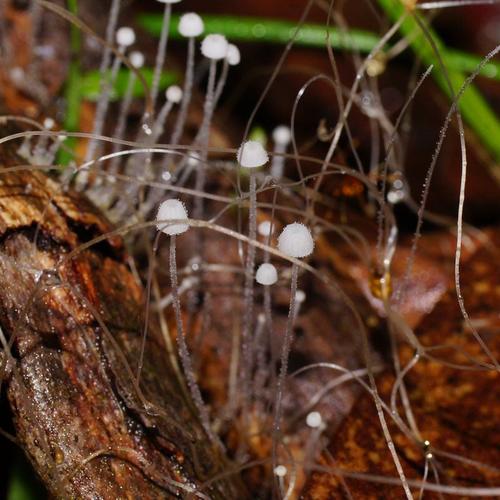
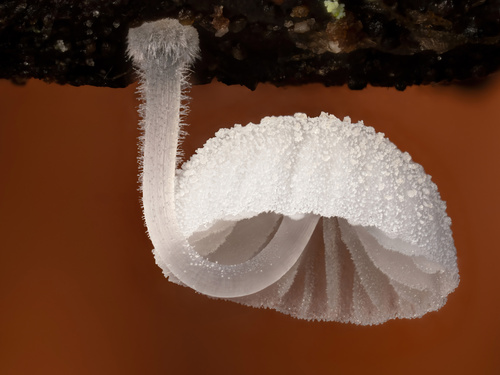
This species is scientifically named Mycena tenerrima (Berk.) Quél. The cap is small and white, typically 2.5 to 7.5 mm (0.1 to 0.3 in) in diameter. When young, it is initially convex to cucullate, or hood-shaped, then flattens as it matures, developing visible surface grooves that line up with the gills underneath the cap. The cap surface may be covered with glistening particles, which are remnants of the partial veil. Young caps are pallid gray with a whitish margin, but quickly become entirely white. The flesh is membranous, fragile, and thin, measuring less than 0.5 mm thick. The gills are either free from attachment to the stem or narrowly adnexed (attached) to it. They grow up to 0.5 mm broad, are distantly spaced, and usually number between 7 and 12 total. Sometimes they adhere to each other to form a slight pseudocollarium, a loose collar, around the stem. They stay translucent-white throughout their development, and have a fringed, white edge. The stem is hollow, 0.5 to 2 cm (0.2 to 0.8 in) long, usually curved and thread-like. The bottom of the stem enlarges into a slight bulb that is nearly spherical when young. At the very base of the stem is a small, white, hairy disk-like structure that anchors the mushroom to its growing substrate. The edibility of this mushroom is unknown. Like many small Mycena species, it is insubstantial and not likely to be considered edible. The variety M. tenerrima var. carpophila is distinguished by its tiny white cap up to 1 mm in diameter, and narrowly conical caulocystidia, which are cystidia that grow on the stem. In terms of microscopic characteristics, this fungus (previously referenced as Mycena adscendens) produces a white spore print. Its spores are broadly ellipsoid, amyloid, and measure 8–10 by 5–6.5 μm. Basidia, the spore-bearing cells, are two-spored, club-shaped, and measure 14–17 by 7–9 μm. Pleurocystidia, cystidia on the gill faces, may be either present or absent; when present, they resemble the cheilocystidia found on the gill edges. Cheilocystidia are abundant, measure 28–44 by 8–12 μm, and are variable in shape. They are often fusoid-ventricose, meaning fuse-shaped with a swollen center, or have 2–3 needle-like projections growing from their apex; these projections may sometimes be forked. The swollen portions of the cheilocystidia are covered in short rodlike protuberances or warts. The gill flesh stains vinaceous-brown when treated with iodine. The cap flesh is made up of greatly enlarged cells, and the cap surface is covered in club-shaped to almost globular cells measuring 25–40 by about 20 μm. These surface cells have finely verrucose walls, covered in small warts, and all cells except the verrucose ones stain vinaceous-brown in iodine. Clamp connections are abundant in the hyphae. Regarding habitat and distribution, fruit bodies grow scattered or in small groups of two or three on fallen twigs, bark, and hardwood woody debris during spring and autumn. They fruit less frequently on conifer wood, and fruit most commonly after periods of wet weather. They also grow on fallen hazel nuts on the ground; two other Mycena species known to grow on this substrate are M. discopus and M. nucicola. In the United States, it is found from Washington to California. It also occurs in Europe, and has been collected in Amasya Province, Turkey. The variety carpophila, originally described from Denmark, was reported in Japan in 2003.