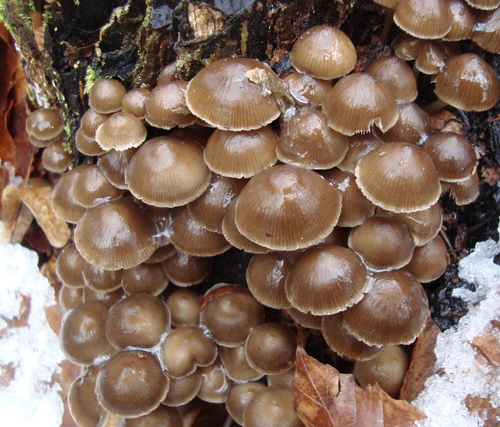
About Mycena nargan Grgur.
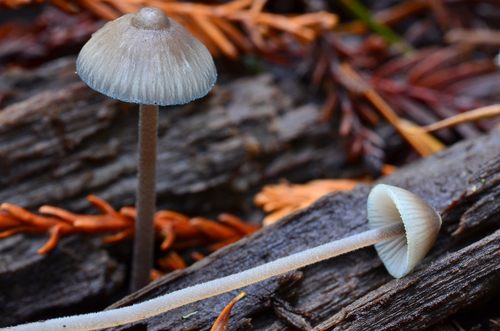
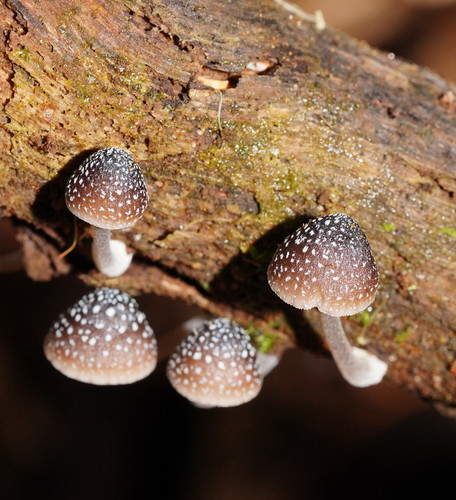
Description: The caps of young Mycena nargan mushrooms start out egg-shaped to conical, then expand to become bell-shaped and reach up to 2 cm (0.8 in) in diameter. When young, the cap margin curls inwards, and it is typically lighter in color than the center of the cap surface. The mushroom is dark brown overall, and is distinguished by white speckles or scales covering both the cap and stem. These scales may be lost when they slough off or get washed away by rain, which can make the species hard to identify. The thick gills have an adnate attachment to the stem—broadly attached to the stem just above the bottom of the gill, with most of the gill fused to the stem—and are white to light grey in color, paler near the edge. There are roughly 24 to 28 gills that extend fully from the cap margin to the stem, plus one or two tiers of lamellulae (shorter gills that do not reach all the way from the margin to the stem). The thin stem grows up to 4 cm (1.6 in) tall and 0.3 cm (0.12 in) wide, and does not have a ring. Young specimens typically have whitish scales at the stem base; over time these scales slough off, and felt-like whitish mycelium may become visible. This mushroom has no distinctive odor. Its spore print is white or cream. The edibility of M. nargan has not been documented. Microscopic characteristics: The spores of M. nargan are roughly ellipsoid, smooth, and hyaline, measuring 7.4–10.4 by 4.8–7.1 μm. They have a small, oblique apiculus, and do not contain oil droplets. In staining reactions, they are acyanophilous (they do not absorb methyl blue dye) and amyloid (they turn blue-black in Melzer's reagent). The basidia (spore-bearing cells in the hymenium) are club-shaped, have clamp connections at their bases, and measure 29.6–36.4 by 8.2–10.7 μm. They are four-spored, and spores attach to the basidia via long, slender sterigmata that reach up to 7.2 μm long. The gill edge is sterile (it bears no basidia) and has abundant cystidia. These thin-walled cheilocystidia vary in shape: they may be swollen in the middle with a beak-like tip, spindle-shaped (fusiform), or club-shaped. They are smooth, hyaline, and inamyloid, with dimensions of 20.8–38.4 by 4.8–10.4 μm, and have a clamp connection at the base. Pleurocystidia (cystidia on the gill face) are not present in this species. Gill tissue is made up of smooth, thin-walled cylindrical to egg-shaped cells, up to 30.4 μm in diameter. These cells are dextrinoid (they produce a black to blue-black positive reaction with Melzer's reagent) and reddish brown. The cap surface (pileipellis) is made of a layer of bent-over filamentous hyphae measuring 1.8–4.8 μm. These loosely arranged hyphae are slightly gelatinised, smooth, thin-walled, hyaline, inamyloid, and have clamp connections. The tissue layer directly under the pileipellis (the hypodermium) has cells that contain brown pigment. Cap tissue consists of smooth, thin-walled, cylindrical to broadly cylindrical or ovoid cells, up to 37.0 μm in diameter, with clamp connections. These cells are dextrinoid and reddish orange-brown in color. The stem surface is made of filamentous hyphae 2.2–4.0 μm in diameter, which are either smooth or have sparse to moderately dense short, rod-like to cylindrical projections. The cells are thin-walled to very slightly thick-walled, hyaline, inamyloid, and have clamp connections. Caulocystidia (cystidia on the stem surface) are not present. Stem tissue consists of short, cylindrical cells up to 28.0 μm in diameter that are smooth and thin-walled, with or without brown pigment in the cytoplasm. These cells have clamp connections and are reddish orange-brown. Habitat and distribution: Mycena nargan is a common mushroom that grows singly or in clusters on the underside of rotting wood in wet, shaded areas, and it grows especially often on Eucalyptus and Pinus pinaster. Fruit bodies usually appear from April to June. The species has been recorded from Tasmania, Victoria, and southeastern South Australia. The Australian Fungimap initiative has recorded isolated collections in Western Australia, South Australia, and New South Wales, though most sightings are from Tasmania and Victoria. This fungus is saprobic, meaning it gets its nutrients from dead or dying organic matter. A field study conducted in Tasmania found that M. nargan is far more likely to occur in mature eucalypt forest (defined as forest that has regrown for at least 70 years since the last wildfire) than in young regenerating forest that had been clearfelled, burned, and sown two to three years before the study.