About Mycena maculata P.Karst.
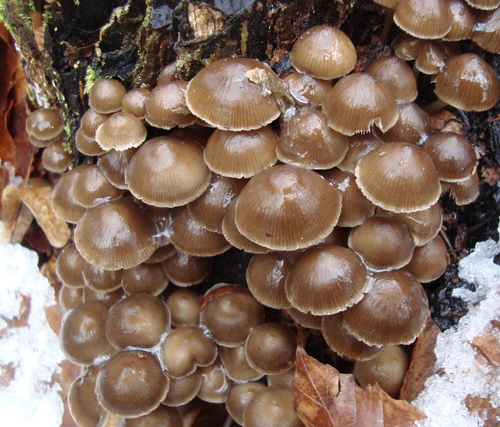
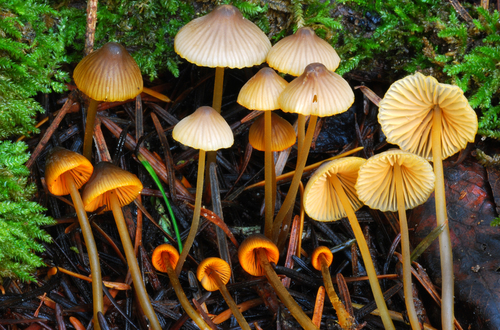
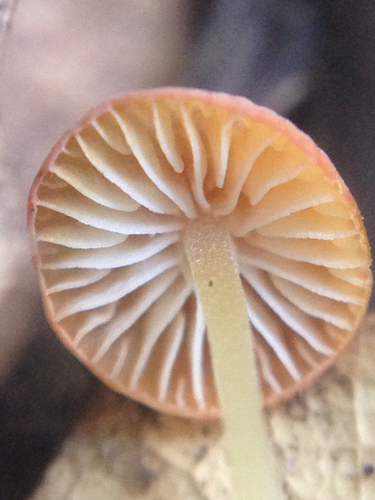
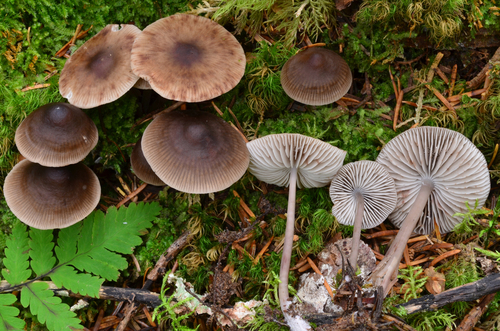
Mycena maculata P.Karst. has caps that start out broadly conical to convex, then quickly expand to bell-shaped or broadly convex when mature. Expanded caps typically measure 2 to 4 cm (3⁄4 to 1+1⁄2 inches) in diameter, and most have a distinct umbo that can be abruptly convex in some specimens, or very broad and low in others. When young, the cap margin lies close to the stem, but often flares or curves upward as the mushroom ages. The cap surface is smooth, slimy to the touch, and usually opaque when young; it becomes partially translucent over time, so the outlines of the gills underneath the cap can be seen nearly to the center before fading. The cap often becomes somewhat wrinkled with age, or develops deepening radial gill grooves. Young caps are dirty blackish-brown or nearly black, fading to paler dirty brown or brownish-gray as they mature, and usually develop reddish-brown spots. The flesh is somewhat thick under the umbo, and becomes abruptly thinner near the cap margin, measuring around 0.15 mm there. It is firm and cartilaginous, colored dark or pale watery gray, and slowly changes to dirty reddish-brown when cut or bruised. It has no distinguishable odor, and its taste ranges from mild to slightly farinaceous, meaning it tastes like flour. The gills are bluntly adnate, and become toothed and somewhat sinuate as they mature. They start narrow and grow to moderately broad (4–5 mm), are whitish to pale gray, and quickly develop reddish stains. Sometimes gills separate slightly from the cap but remain attached to each other to form a collar. Gills are spaced from close to subdistant, with 17–24 gills reaching the stem, plus approximately three tiers of lamellulae, which are short gills that do not extend fully from the cap margin to the stem. The stem is usually 4–8 cm (1+1⁄2–3+1⁄4 inches) long and 2–5 mm (1⁄16–3⁄16 inches) thick, and may occasionally be much longer. It often has a long, cordlike, root-like pseudorhiza 1–5 cm (1⁄2–2 inches) long that roots into the substrate. The lower portion of the stem is densely covered with sharp, stiff white hairs, and the upper portion is smooth. The stem is sometimes twisted, roughly equal in width along its length, hollow, and cartilaginous. The top section of the stem is pallid, and the rest of the stem matches the cap color or is paler. The stem base stains reddish-brown to purplish, or the entire lower stem turns a dirty wine red. The edibility of this mushroom is unknown. Microscopically, the spores are white, ellipsoid, amyloid (they turn bluish-black to black when stained with Melzer's reagent), and measure 7–9 by 4–5 μm. The spore-bearing basidia in the hymenium are 30–35 by 7–8 μm and four-spored. Cheilocystidia, cystidia located on the gill edge, are embedded in the hymenium and inconspicuous, measuring 20–28 by 6–12 μm. They have irregular forms: some have short rodlike projections on the upper portion, others have irregular branched finger-like protuberances, and others have wavy walls and an elongated contorted apex. Mycena maculata does not have pleurocystidia, which are cystidia on the gill face. Gill tissue is hyaline or very faintly vinaceous-brown when stained with iodine. Cap tissue has a thin pellicle; the region directly under the pellicle is made of hyphae with only slightly enlarged cells, while the rest of the cap tissue is filamentous, and stains yellowish to slightly vinaceous-brown in iodine. The mycelium of M. maculata is bioluminescent; this property has not been reported for its fruit bodies. Fruit bodies grow in groups or clumps on the wood and debris of both coniferous and deciduous trees. The fungus occurs in North America and Europe, specifically Germany and Norway. In North America, its range extends north from Quebec, Canada, south to Mexico. Mycena specialist Alexander H. Smith, in his 1947 monograph on the genus Mycena, called it "the most abundant Mycena on conifer wood in the Pacific Northwest." It was also recorded as a new record for Turkey's Kahramanmaraş district in 2006.