About Mycena interrupta (Berk.) Sacc.
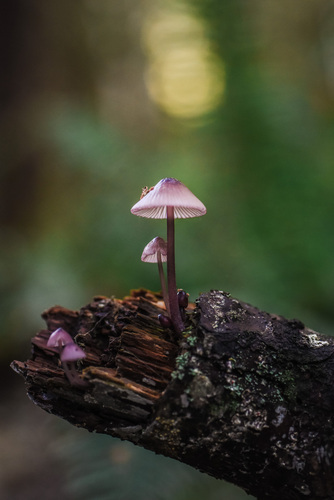
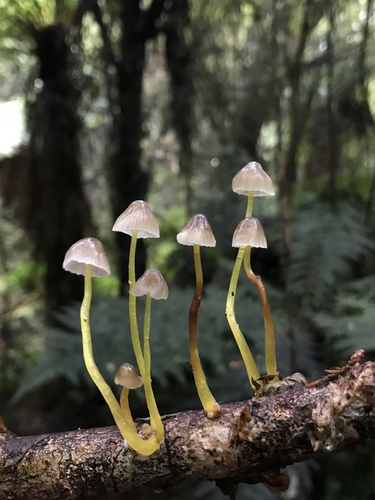
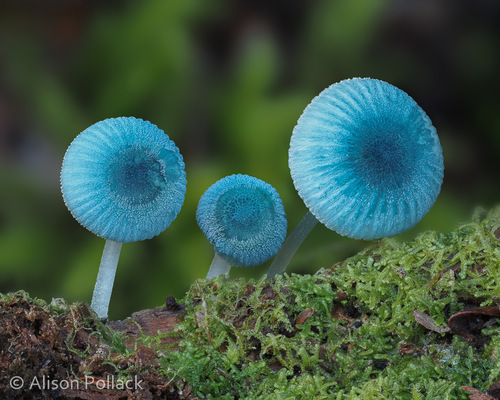
Mycena interrupta has caps that measure between 0.8 and 2 cm across, and are a bright cyan blue in color. When the fungus first emerges, its cap is globose; as it matures, it develops into a broad convex shape with a slight depression at the center. Caps are often sticky and look slimy, especially in moist weather. The stipe (stem) is typically 1 to 2 cm long and 0.1 to 0.2 cm thick. It is white and smooth, and its base attaches to wood substrates via a flat white disk. This attachment differs from that of Roridomyces austrororidus, which attaches to wood through a mass of clumped fine hairs. The gills are white, adnexed, and have blue edges. The spores are white, smooth, and ellipsoid, with a size of 7–10 × 4–6 μm. Unlike many other Mycena species, Mycena interrupta is not bioluminescent. Commonly called pixie's parasol, this fungus grows in small colonies on rotting, moist wood in rainforests, beech forests, and eucalypt forests. It has a Gondwanan distribution.