About Mycena haematopus (Pers.) P.Kumm.
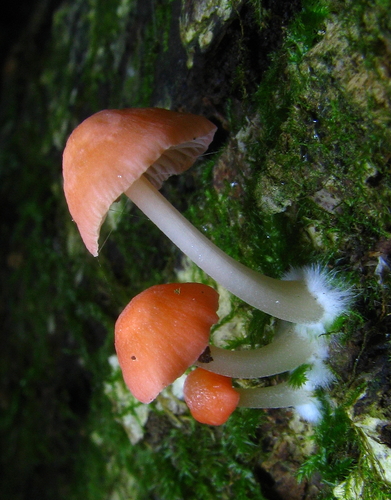
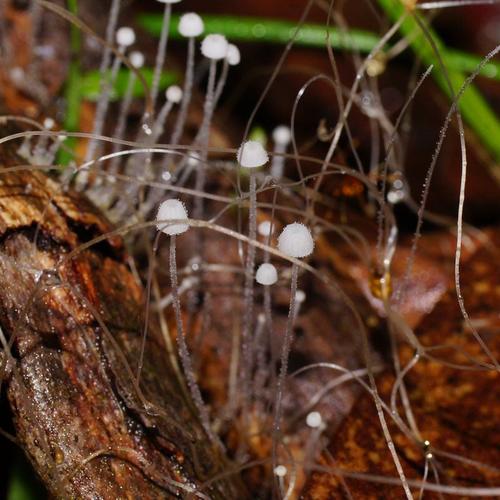
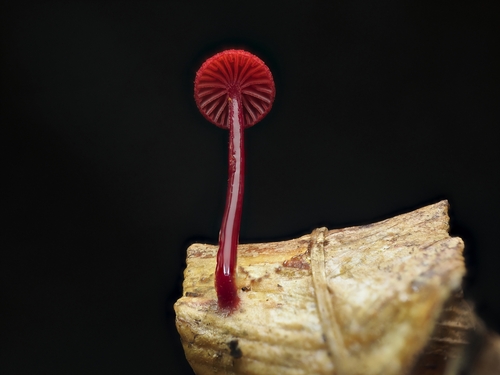
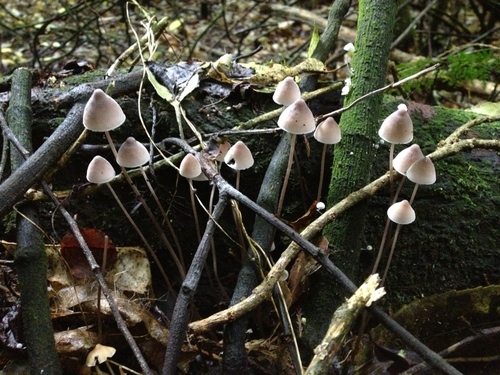
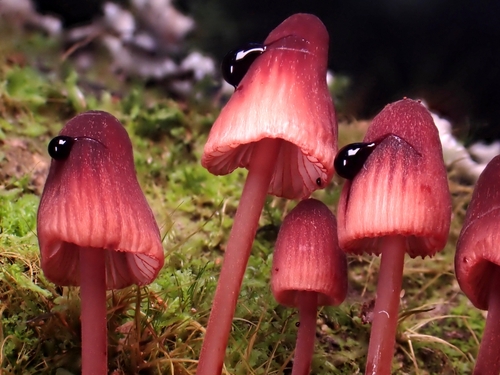
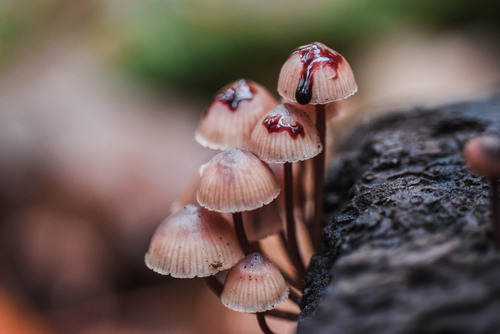
Mycena haematopus (Pers.) P.Kumm. produces fruit bodies, its reproductive structures, from hyphae that grow in rotting wood. Cap shape changes with maturity: young caps (called buttons) are egg-shaped to conical, then become bell-shaped as they develop. As the fruit body matures, the cap edges lift upward, and mature caps become somewhat flat with a central nipple-shaped bump called an umbo. Fully grown caps reach up to 4 cm (1+5⁄8 in) in diameter. The cap surface is initially dry and covered in a fine whitish powder, but soon becomes polished and moist. Mature caps are somewhat translucent, and develop radial grooves that match the position of the gills underneath the cap. Cap color is reddish- or pinkish-brown, often with a violet tint, and is paler toward the cap edge. The margin is wavy like a scallop edge, and may look ragged from remaining partial veil remnants. The gills attach to the stem in an adnate arrangement, meaning they attach more or less directly to the stem. They are initially whitish or grayish vinaceous, and can develop reddish-brown stains. Between 20 and 30 gills extend from the cap edge to the stem, giving a gill spacing described as close to subdistant, where gaps are visible between adjacent gills. Shorter additional gills called lamellulae do not reach all the way from the cap margin to the stem; these are arranged in two or three tiers of equal length. The stem grows 3–9 cm (1+1⁄8–3+1⁄2 in) tall and 0.1–0.2 cm (1⁄32–3⁄32 in) thick. It is hollow, brittle, and dark reddish-brown. In young fruit bodies, the upper stem is densely covered in a pale cinnamon-colored powder that wears away as the mushroom ages. The stem has a mass of coarse hairs at its base. The mushroom's flesh ranges from pale to vinaceous (red wine-colored), has no distinctive odor, and oozes red latex when cut or injured. Its flavor is mild to slightly bitter. For microscopic characteristics, the spore print of Mycena haematopus is white. The spores are elliptical, smooth, and measure 8–11 by 5–7 μm. They are amyloid, meaning they absorb iodine when stained with Melzer's reagent. The spore-bearing basidia are 4-spored. Sterile cells called cystidia are numerous on the gill edges; they measure 33–60 μm (sometimes up to 80 μm) by 9–12 μm. Cystidia on the stem (called caulocystidia) grow in clusters, are clublike to irregular in shape, and measure 20–55 by 3.5–12.5 μm. The gill tissue contains numerous lactifers, the specialized cells that produce the latex secreted when the mushroom is cut. The surface mycelium is whitish and fluffy. Swelling at the terminal tips of hyphae (up to 12 μm in diameter) is present but not very abundant, and moniliform hyphae are very rare. The species produces extracellular oxidase enzymes, consistent with its ecological role as a saprobe. In terms of distribution, habitat and ecology, in North America, Mycena haematopus ranges from Alaska southward. Mycena specialist Alexander H. Smith notes it is "the commonest and the most easily recognized one in the genus". It is common in Europe, and has also been collected from Japan, and Mérida, Venezuela (as the variety M. haematopus var. marginata). In the Netherlands, it is one of the mushroom species that can regularly be found fruiting on ancient timber wharves. Fruit bodies can appear year-round in mild weather. This mushroom is saprobic, meaning it gets nutrients from decomposing organic matter, and its fruit bodies typically grow on stumps and well-decayed logs, usually in grouped clusters joined at a common base. Decomposition of woody debris on forest floors comes from the combined activity of a whole community of fungal species. In the sequential succession of mushroom species that colonize decaying wood, M. haematopus is a late colonizer: its fruit bodies appear only after the wood has already been decayed by white rot fungal species. The initial stage of wood decay by white rot fungi breaks down acid-unhydrolyzable residue and holocellulose, a mixture of cellulose and hemicellulose. Mycena haematopus can be parasitized by Spinellus fusiger, another fungal species that gives the infected mushroom a distinctly hairy appearance.