About Mycena chlorophos (Berk. & M.A.Curtis) Sacc., 1887
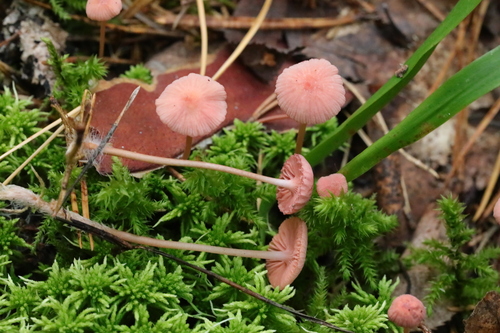
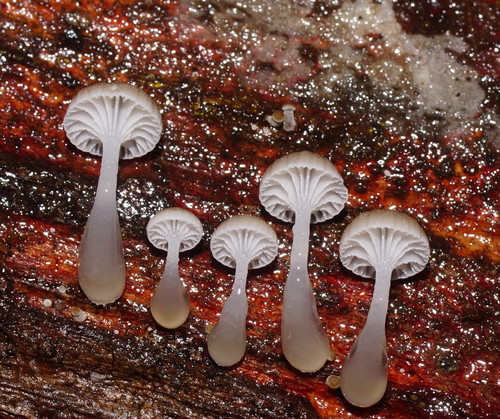
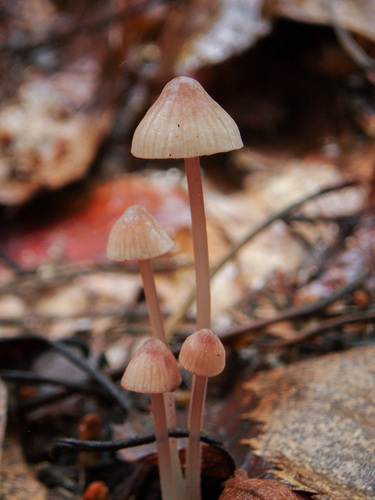
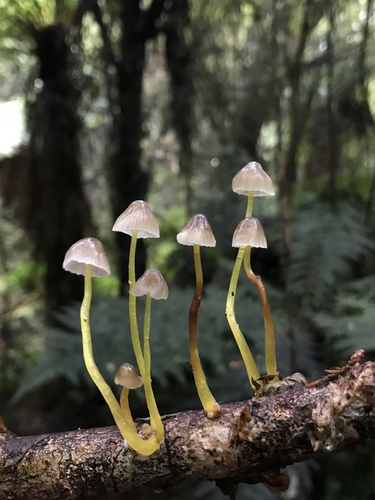
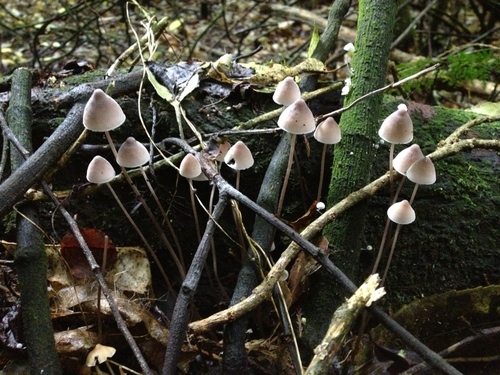
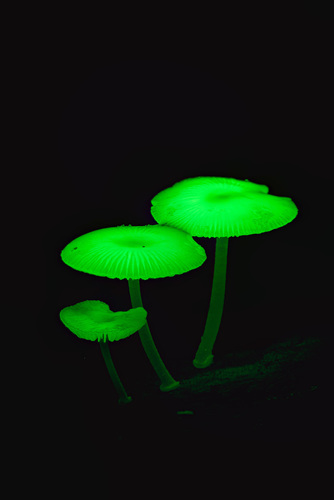
Mycena chlorophos (Berk. & M.A.Curtis) Sacc., 1887, has a cap that is initially convex, before flattening out and sometimes developing a central depression; it reaches up to 30 mm (1.2 in) in diameter. The cap has radial grooves that extend nearly to its center, sometimes develops cracks on its margin, which bears small rounded teeth. It is pale brownish gray, a color that fades as the cap expands, and the cap surface is somewhat sticky. The stem is white, 6–30 mm (0.24–1.18 in) long, 0.3–1 mm thick, hollow, translucent, and covered in tiny surface hairs. The base of the stem is disc-shaped or somewhat bulbous, and measures 1–2.5 mm wide. The thin gills are either free (not attached to the stem) or adnexed, which means they are narrowly attached to a slight collar that encircles the stem. Gills start white before turning grayish, and they are somewhat crowded; there are 17–32 full-length gills, plus 1 to 3 tiers of lamellulae, which are shorter gills that do not extend fully from the cap margin to the stem. Gills are 0.3–1 mm wide with micaceous edges. The flesh is very thin, and has a strong odor of ammonia. Both the cap and gills of this species are bioluminescent, while the mycelia and stems have little to no luminescence. The spores are white, smooth, roughly elliptical, and measure 7–8.5 by 5–6 μm. The spore-bearing basidia are 17–23 by 7.5–10 μm, four-spored, with sterigmata around 3 μm long. Paraphyses are 5–8 μm wide, shorter than basidia, more abundant than basidia, and form a somewhat gelatinous layer. Cheilocystidia, cystidia located on the cap edge, measure 60 by 7–21 μm, are hyaline, and conical or ventricose (inflated). The tips of cheilocystidia taper to a point, or bear a short appendage that measures 15 by 2–3 μm; this appendage is sometimes branched, and has a thin or slightly thickened wall. There are no cystidia on the gill face, which are called pleurocystidia. Pileocystidia, cystidia on the cap surface, are club-shaped and measure 25–60 by 13–25 μm. They have somewhat thick walls, and their exposed surface is spiny, with short simple outgrowths that extend up to 3 μm long. Pileocystidia join together to form a continuous layer over the young cap, but break apart as the cap expands. Caulocystidia, cystidia on the stem, are conical or lance-shaped, hyaline, smooth, and have thin or slightly thickened walls. They can measure up to 300 by 10–25 μm, and are shorter on the upper regions of the stem. Clamp connections are present in the hyphae of all tissues of this fungus. Fruit bodies of Mycena chlorophos grow in groups in forests, on woody debris including fallen twigs, branches, and bark. On Japan's Hachijo and Bonin Islands, these mushrooms grow predominantly on decaying petioles of the palm Phoenix roebelenii. This fungus requires a specific humidity range to produce mushrooms; for example, on Hachijo Island, fruiting only occurs during the rainy seasons of June/July and September/October, when relative humidity is around 88%, usually one day after rain. Experimental studies show that overly wet mushroom primordia become deformed, while too dry conditions cause the caps to warp and break, as the delicate gelatinous membrane covering them ruptures. Across Asia, this species has been recorded in Japan, Taiwan, Polynesia, Java, and Sri Lanka. In Japan, the fungus is becoming rarer as its natural habitat declines. Several Australian field guides have documented this species from Australia. It has also been recorded multiple times in Brazil. Mycena chlorophos was one of several fungi featured on a set of postage stamps issued by Samoa in 1985.