About Mycena acicula (Schaeff.) P.Kumm.
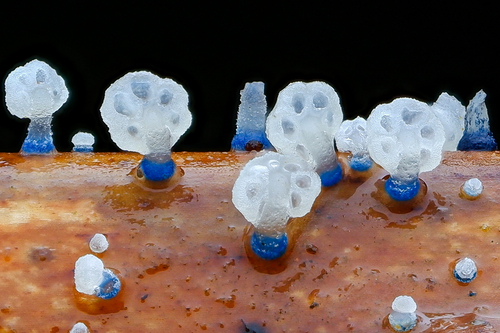
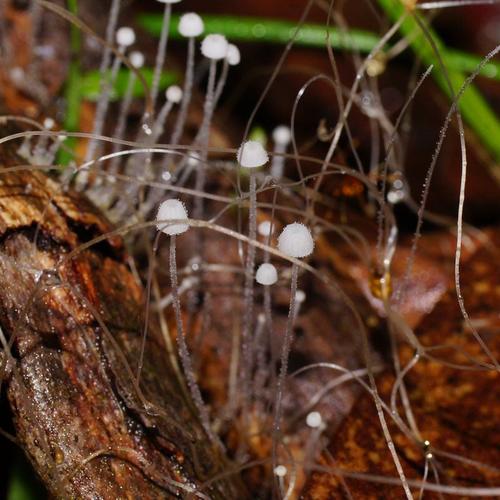
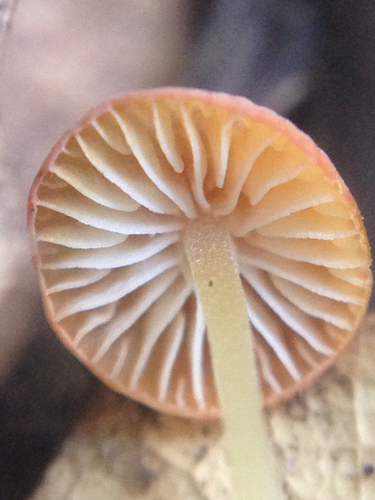
This species is Mycena acicula (Schaeff.) P.Kumm. Its cap is initially convex, and expands to a bell shape as it matures, typically reaching 0.3 to 1 cm (0.1 to 0.4 in) in diameter. The cap sometimes has a small, abrupt umbo, a central bump. When young, the cap margin is pressed closely against the stem, and often flares or curves slightly inward as the cap ages. As the cap expands, a narrow sterile band, a region without the reproductive cells typical of the hymenium, frequently forms at the extreme margin, and this band often becomes lobed or irregularly jagged. The cap surface is smooth, faintly translucent-striate when moist, and is pruinose at first, but soon becomes naked. Young caps are red, which soon fades to yellowish toward the margin, and slowly changes overall to bright orange-yellow. The flesh is thin, brittle, and yellow, with no distinctive odor or taste. The gills are adnate, meaning they are broadly attached to the stem slightly above the bottom of the gill, with most of the gill fused to the stem, or slightly rounded where they meet the stem. Individual gills are spaced close to subdistant; between 10 and 14 gills reach the stem, and there are two or three tiers of lamellulae, short gills that do not reach the stem. The gills are moderately broad, pale orange to whitish, often yellowish at the base and whitish along the edges. The stem is 1 to 6 cm (0.4 to 2.4 in) long, and up to 1 mm thick; it is flexuous, winding from side to side, and brittle, with the base covered in sharp, straight, stiff white hairs. The stem surface is densely white-pruinose initially, but soon becomes naked, and shifts color to orange-yellow or lemon yellow. One description notes that this species is "a delight to behold", but "one usually has to get down on hands and knees to find it!". The spore print is white. For microscopic characteristics: spores are roughly spindle-shaped, tapering at each end, and measure 9–11 by 3.5–4.5 μm. They are nonamyloid, meaning they do not take up iodine when stained with Melzer's reagent. The spore-bearing basidia are club-shaped, four-spored, and measure 20–22 by 5–6 μm. Cheilocystidia and pleurocystidia, cystidia found on the edge and face of a gill respectively, are similar in shape: they are club-shaped to spindle-shaped or egg-shaped, and their apices are often covered with a resinous secretion. The hyphae that make up the cap cuticle are up to 3.5 μm wide, clamped, and covered with cylindrical excrescences that measure 2–9 by 1–3 μm. The hyphae of the stem's cortical layer are up to 4.5 μm wide, clamped, and densely covered with simple to somewhat branched, cylindrical to inflated excrescences that are up to 20 by 5 μm. These last excrescences are embedded in gelatinous matter. For habitat and distribution: fruit bodies grow singly, in groups, or somewhat clustered on debris in wet places, especially along streams or at the borders of swamps. The appearance of the fruit bodies is not significantly influenced by rainfall; this may be because "such minute fungi are largely determined by the microenvironment prevailing under dense vegetation, etc., which is no doubt less affected by recent rain than more exposed situations." The fungus is widely distributed throughout eastern United States and Canada, and also occurs in Washington, Oregon, and California along the Pacific Coast. It has also been reported from Trinidad, Britain, Norway, Spain, Korea, and the Ussuri River Valley in northeast China.