About Mycalesis patnia Moore, 1857
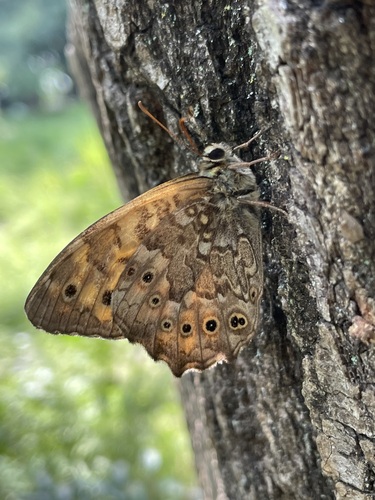
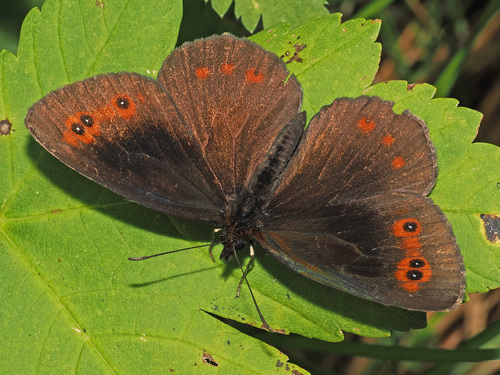
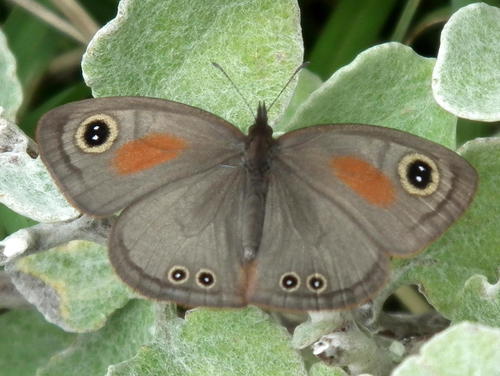
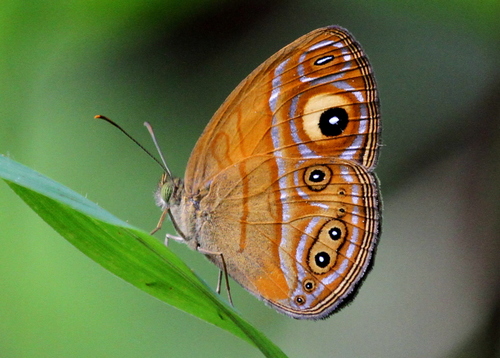
This species is Mycalesis patnia Moore, 1857. Males have a dark umber-brown upperside ground colour, slightly suffused with ochraceous. Both forewings and hindwings bear bright, slender ochraceous-yellow sub-terminal and terminal lines, with pale brown cilia. The forewing has a large median and a much smaller subapical black ocellus, both white-centred with an orange-yellow iris. The upper portion of the iris around the median ocellus is very broad, while the lower portion is incomplete, and there is a more or less triangular orange-yellow discal patch. The hindwing is uniform, with two very small black ocelli ringed with fulvous. The male underside is deep ochraceous yellow, with subterminal and terminal lines matching those on the upperside. Both forewing and hindwing are crossed near the base by a darker ochraceous-yellow line, followed by a silvery discal band. Beyond this band lie two ocelli matching the upperside ocelli, but each is additionally encircled by an outer silvery ring. The hindwing has a curved series of seven similar ocelli, with a silvery band bordering the ocelli on both sides. The third and fourth ocelli from the tornus are together placed on a brighter ochraceous patch encircled with black, and the apical ocellus is placed alone on such a patch. Antennae, head, thorax and abdomen are brown, and somewhat ochraceous on the undersides. One morph of the male has a sex-mark. Females are similar to males, but have stronger ochraceous suffusion on the upperside. The orange-yellow forewing patch is larger, spreading to the wing base, and there are no ocelli on the hindwing. The female underside matches the male's, but is a brighter shade of ochraceous yellow. The basal area of both forewing and hindwing is crossed by two darker yellow bands, and the discoidal cell of the forewing contains an interior loop of the same darker colour. The southern Indian subspecies, M. p. junonia, is identical to the nominate subspecies from Sri Lanka aside from the following differences: its upperside is a duller brown, the median forewing ocellus is encircled with pure white, and there is no discal patch, or only faint traces of one. Its underside markings match those of nominate M. p. patnia, but the entire underside is a duller, browner shade with no general ochraceous tint. Males of this subspecies have a large bright ochraceous spot on the posterior of the hindwing, and the median forewing ocellus is broadly encircled with white. Male sex-marks are present in one morph of this subspecies. The wingspan of Mycalesis patnia ranges from 42 to 54 mm.