About Mycale laevis (Carter, 1882)
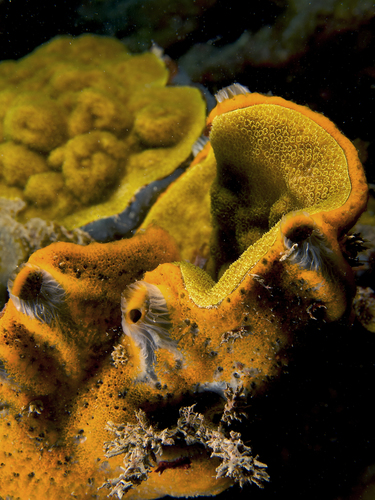
Mycale laevis can be yellow, mid to dark orange, or yellowish-green. It has a small number of oscules, each reaching up to 4 millimetres (0.16 in) in diameter. The oscules are elevated, and each has a thick opaque to translucent white collar. This sponge has a firm texture but tears easily. Mycale laevis occurs on reefs in the Caribbean Sea, the Gulf of Mexico, the West Indies, the Bahamas, and Florida, at depths ranging from 1 to 80 metres (3.3 to 262.5 ft). It is more common at depths greater than 25 metres (82 ft). Mycale laevis usually grows on the undersurface of flat plate-forming coral species, including various species in the genera Orbicella, Montastraea, Porites, Agaricia, and Mycetophilia. The sponge appears to cause the coral’s rim to fold into lobes, and it grows into the gaps between these lobes. It often covers the entire underside of groups of colonial corals. The exact relationship between the coral and the sponge is not clear, but the sponge likely benefits from being held clear of the seabed, while the coral may avoid being host to a parasitic boring sponge. Observations over several years confirm this is a stable relationship. When no suitable coral species are available, Mycale laevis can live directly on rocks and under boulders as an encrusting or massive sponge, and can also grow on calcareous worm tubes.

