About Myadestes townsendi (Audubon, 1838)
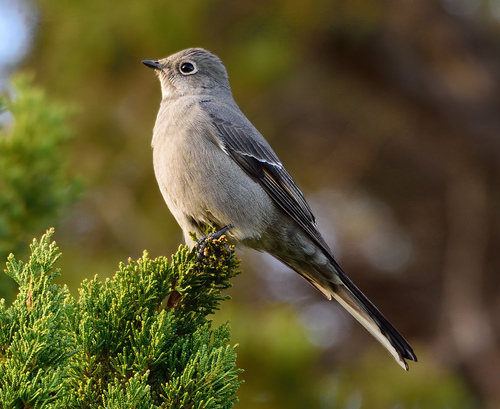
Townsend's solitaire (Myadestes townsendi) reaches approximately 8–9.5 inches (20–24 centimeters) in length, with an average wingspan of 14.5 inches (37 cm) and an average weight of 1.2 oz (34 g). This bird has a short, thick, blackish bill, a distinct white eye ring, and overall gray plumage. It has a buffy wing stripe and buffy edges along its flight feathers. Its tail is long, tapered when closed, and edged with white. Juvenile Townsend's solitaires have mottled gray and white plumage. This species typically perches in an upright position, often on high branches, and will often stay still for long periods of time. While it shares some similarities with the northern mockingbird, especially in the appearance of its tail, it differs from that species in its dark underparts, body shape, overall size, and behavior. Townsend's solitaire feeds primarily on berries and insects. It is among the most specialized of all North American birds, because its winter diet consists almost entirely of the fleshy cones of juniper bushes. Solitary individuals of this species establish territories around productive juniper patches, which they defend aggressively. The range of Townsend's solitaire extends from southern Alaska, British Columbia and Alberta in the north, down to northern Zacatecas in Mexico. This species prefers to live in montane woodlands. During winter, it may move to lower elevations to search for food, including areas of the Great Plains, northern interior Mexico, and even desert oases.