About Myadestes occidentalis Stejneger, 1882
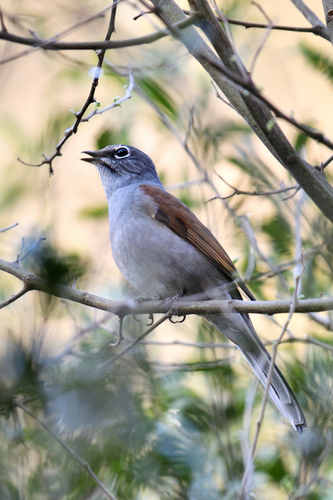
Myadestes occidentalis Stejneger, 1882, commonly known as the brown-backed solitaire, measures 20.5 to 21.5 cm (8.1 to 8.5 in) long and weighs 38 to 44 g (1.3 to 1.6 oz). Males and females have identical plumage. Adults of the nominate subspecies M. o. occidentalis have a mostly dull darkish gray head, with black lores, a white stripe above the lores, a broken white eye-ring, a white "moustache" stripe, black cheeks, and a white chin and upper throat. Their upper back is dull darkish gray, transitioning to olive-rufous on the rump and tail; the outer tail feathers have white tips. Their scapulars and the edges of their wing feathers are a richer rusty brown. Their breast is dull darkish gray, fading to paler gray on the belly. They have a black bill and grayish pink legs and feet. Juveniles look similar to adults, but have whitish buff edges on their body feathers that create a spotted appearance. Subspecies M. o. insularis has more white on the throat and slightly paler gray upperparts than the nominate subspecies. Subspecies M. o. oberhoseri has more extensive, deeper gray underparts than the nominate, along with reddish brown legs and feet. The brown-backed solitaire has a disjunct distribution. The nominate subspecies occurs in western Mexico, ranging from Sonora south to Oaxaca. M. o. insularis is found on the Tres Marias Islands off the coast of Nayarit. M. o. oberhoseri ranges from Nuevo León in northeastern Mexico south to Oaxaca, also occurs in Chiapas, and occupies several separate ranges in southern Guatemala, El Salvador, and southwestern Honduras. There are two records of the species from Cochise County, Arizona, U.S.A., which are believed to document the same individual. The bird was first photographed on July 16, 2009, then photographed and audio recorded a few miles away between July 18 and August 1, 2009. This species has been added to the Check-list of North American Birds and the American Birding Association's checklist; the American Birding Association lists it as a "Code 5" species. Several earlier reports of the species from the U.S. were not accepted, due to uncertainty about the birds' origin, because the species is a common cage bird in Mexico. The brown-backed solitaire lives in a variety of forest types within the subtropical zone, including cloudforest, pine-oak forest, montane evergreen forest, lowland evergreen forest, and semi-deciduous forest. Overall, it occurs at elevations from roughly 300 to 3,500 m (1,000 to 11,500 ft). In areas south of Mexico, it ranges from 600 to 3,050 m (2,000 to 10,000 ft), but is most often found above 1,450 m (4,800 ft).