About Mya truncata Linnaeus, 1758
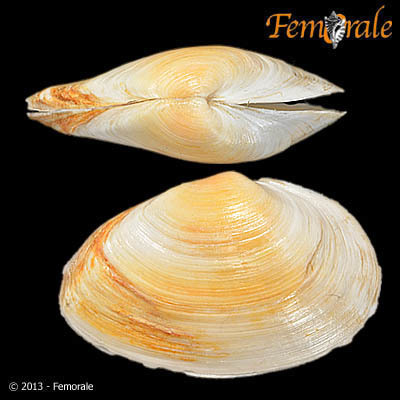
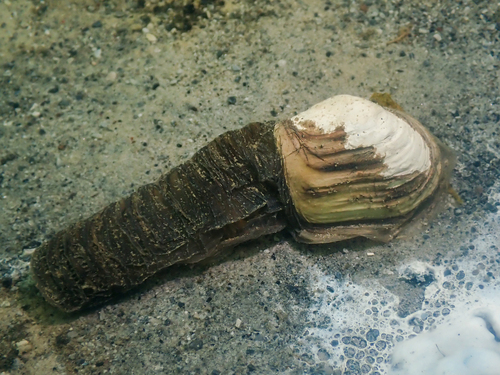
Description: The shells of Mya truncata typically reach 2.5 to 7.5 centimeters (0.98 to 2.95 inches) in size. These bivalves are closely related to soft-shell clams (Mya arenaria), but they are usually smaller and have less elongated shells. Their two valves are rounded at the anterior end and truncated at the posterior end, with a large gape that lets an extensible siphon pass through. This siphon can grow up to four times the length of the shell, and can be fully retracted back into the shell. The two valves are triangular and convex, with the right valve more convex than the left. The siphon is covered by a protective horny sheath, and has small tentacles at its tip. The outer surface of the valves is marked with concentric growth lines, and is whitish in color. The outermost layer of the valves, called the periostracum, may range from yellowish or light olive to dark brown. The hinge of the left valve has a spoon-shaped projection that the ligaments attach to, and the pallial sinus is deep and broad. Distribution and habitat: This species is widespread across Arctic seas. Its range extends south to the Bay of Biscay, along the West Atlantic coast, and to Sakhalin on the Pacific coast. It has also been recorded in the waters surrounding Japan. Mya truncata lives burrowed in sand or sandy mud, ranging from the lower shore down to depths of 70 meters.