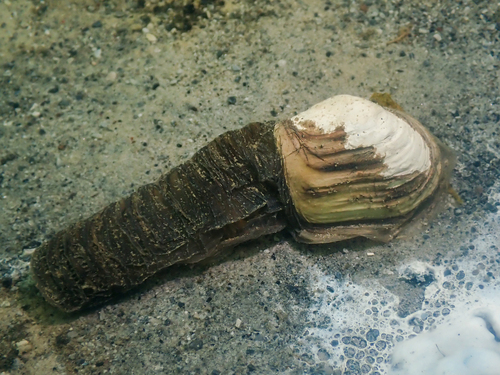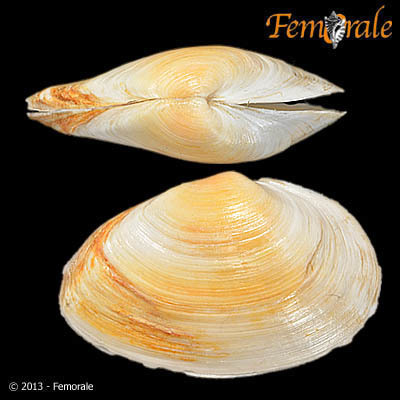
About Mya arenaria Linnaeus, 1758
This species has the scientific name Mya arenaria Linnaeus, 1758. In American English it is called soft-shell clam, and in British English and Europe it is called sand gaper. It has many popular common names: "steamers", "softshells", "piss clams", "Ipswich clams", and "Essex clams". It is a species of edible saltwater clam, a marine bivalve mollusk that belongs to the family Myidae. These clams live buried in sediment on tidal flats. Though they are common in purely muddy areas, their specific epithet "arenaria" means sandy, and they prefer habitats that combine both sandy and muddy areas. This species is well known as a food item along the coast of New England in the Western Atlantic Ocean, but its natural range extends much farther north into Canada and farther south to the Southern United States. It is also found throughout the Eastern Atlantic Ocean, including in the United Kingdom and the Wadden Sea of the North Sea, where it is the dominant large clam. The species was first detected in the Soviet Union in 1966, and soon after, its population exploded in the northwestern and western parts of the Black Sea, as well as in the Sea of Azov. From 1921 to 2021, the species was abundant in Kola Bay. In modern Russia, the species was discovered for the first time in the Tuloma River. Since that discovery, the highest abundance of the species has been recorded at Khlebnaya, the lowest abundance at Belokamennaya, and Vayenga Bay holds no individuals of this species at all. This species has become invasive on the Pacific coast of North America, including Alaska, Canada, and the continental United States. Despite this modern invasive status, M. arenaria originally originated in the Pacific Ocean during the Miocene epoch. It expanded its range into the Atlantic, including European waters, during the early Pliocene. Both Pacific and European populations went extinct at some point in the early Pleistocene, leaving only the Northwest Atlantic population, which has since spread to its current modern distribution via human activity. It also occurs in the Mediterranean Sea.