About Mutilla europaea Linnaeus, 1758
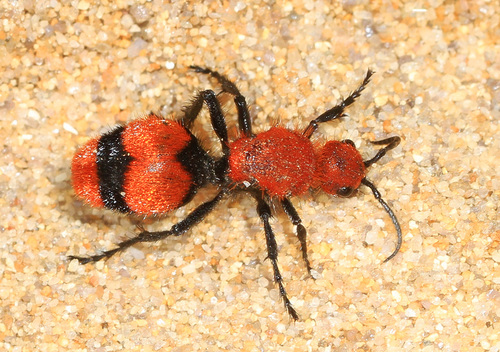
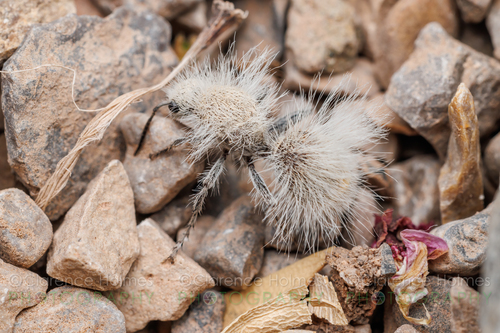
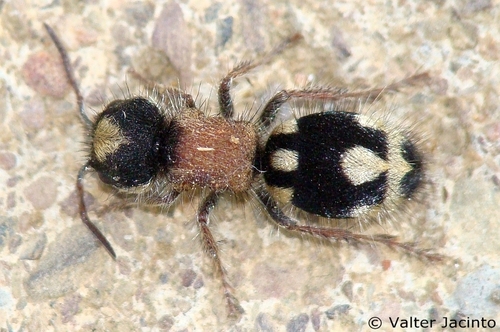
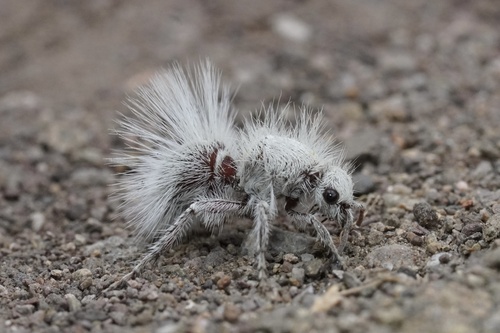
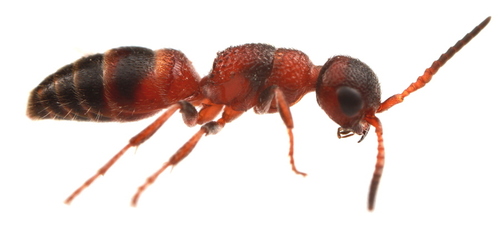
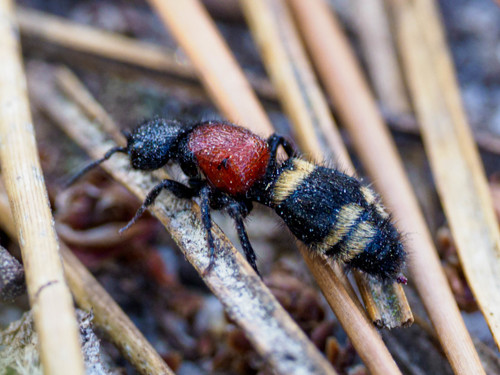
Male Mutilla europaea have dark red coloring on the apex of the mandible and the thorax. The first and second abdominal terga have bands of long silver setae; the band on the second tergum may be interrupted or wavy. The sides of the second tergum are covered in long silver setae. The tip of the abdomen and the rest of the body are covered in long, straight black setae. The legs are mostly covered in black setae, with a scattering of silver setae. There is some natural variation between specimens: silver setae may dominate the hind legs of some individuals, and some males are completely black. In females, the mesonotum is red, and this red color sometimes extends to parts of the pronotum. The first tergum has a band of long silver setae, and the remaining terga have silver setae spots along their flanks that can be close together. The legs have short, adjacent black and silver setae. The presence of these bristle-like setae gives the species its common name "velvet ant". Mutilla europaea is a widespread species found across most of Europe, reaching as far east as China. It also occurs in Central Asia, the Middle East, and North Africa. In Great Britain it has a local distribution, concentrated mainly in the south and east, though it has recently been recorded as far north as Aberdeenshire. This species lives in heaths, moors, chalk grassland, and woodland. In England, it is most closely associated with lowland heaths, and females are most often recorded running across sandy paths. Like other wasps in the family Mutillidae, M. europaea are parasitoids that target the resting life stages of other insects. The main hosts for this species are various bumblebees in the genus Bombus, though it has also been found infrequently in hives of the Western honey bee (Apis mellifera). After entering a host nest, the female lays an egg into a cocoon that holds the bee's prepupa or young pupa. The wasp larva consumes the host pupa, then spins its own cocoon inside the host's cocoon. The size of the adult wasp that emerges depends partially on the size of its host; wasps that develop in honey bee hosts are smaller than those that use bumblebees as hosts. After emerging, adult wasps feed on the host bees' stored honey. Males die soon after they emerge in autumn, but females hibernate over the winter. Females sometimes hibernate inside the host nest, and may also hibernate at the roots of low-growing vegetation. Winged males are occasionally recorded feeding on nectar, and one documented nectar source is wild parsnip. While females have been recorded visiting flowers, this behavior is very unusual. M. europaea are also cleptoparasites; they have been observed sneaking into nests of the paper wasp Polistes biglumis to steal stored food. They are thought to be able to do this because they can disguise their own scent, so the Polistes wasps cannot detect them. When threatened, these wasps can produce a stridulating sound by rubbing a raised structure called the plectrum, located on the underside of the second tergum, over rows of dense narrow ridges at the base of the adjacent segment. These wasps are very strong with a thick, armoured exoskeleton; related species in North America have been reported to force their way out of the mouths of predators such as lizards and frogs. They also have a painful sting, which gave rise to the colloquial name "cow killer". This name is entirely inappropriate, because although their sting is painful, their venom is far less toxic than honey bee venom. M. europaea are not aggressive, and only sting humans if handled.