About Mustelus henlei (Gill, 1863)
The brown smooth-hound, with the scientific name Mustelus henlei, is a houndshark belonging to the family Triakidae. This shark has a viviparous mode of reproduction. Among males, the reported size ranges from a minimum of 27.6 cm to a maximum of 95.0 cm, while females range from 25.7 cm to 100 cm; males reach their asymptotic length earlier than females. The average adult size of this species falls between 50 and 70 cm, and newborn brown smooth-hounds measure between 19 and 21 cm. Gravid females are around 67.6 cm long, and the average length at maturity is 63.6 cm for males and 65.6 cm for females.
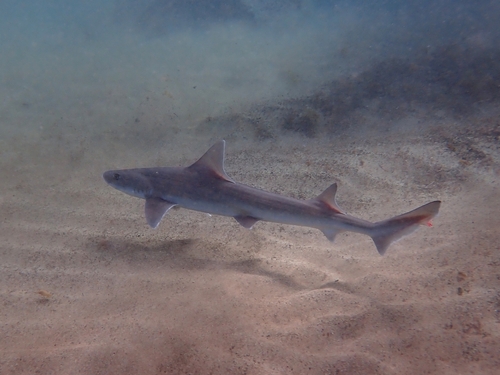
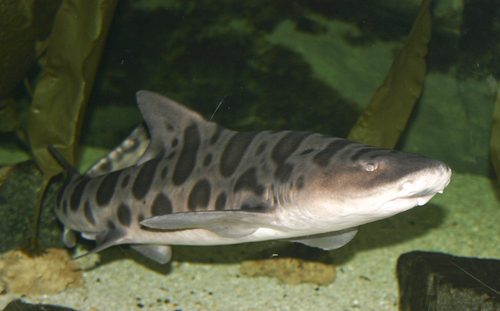
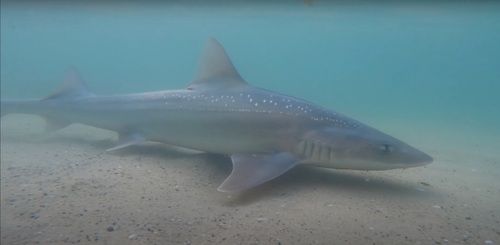
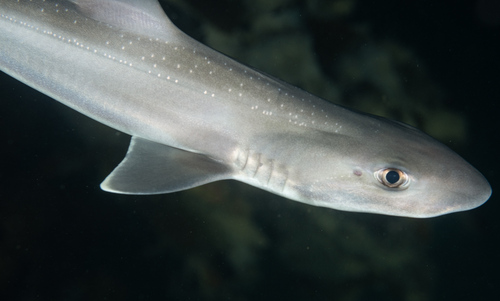
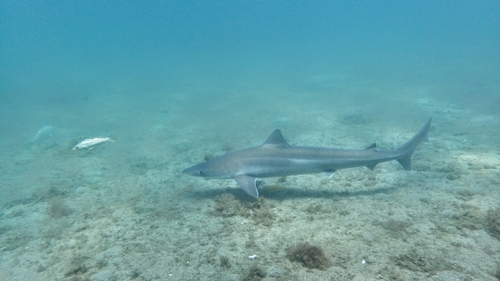
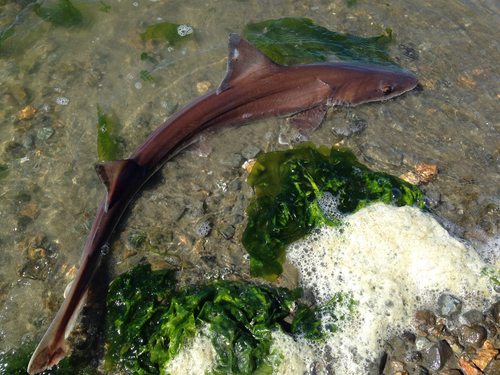
As a ground shark, the brown smooth-hound has a heterocercal caudal fin with an elongated upper lobe, broad triangular dorsal fins, broad pectoral fins, an inferior mouth, and large eyes. Its dorsal coloration is reddish or bronze, and its underside is silvery. The species has a slender body, a long snout, and sharp teeth. Its teeth typically have a narrow primary cusp plus one or two accessory cusplets.
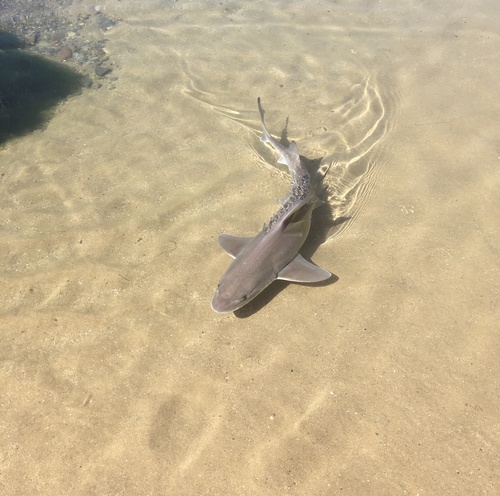
This species is found on continental shelves of the subtropical eastern Pacific, ranging from northern California to the Gulf of California, and also occurs in Ecuador and Peru, between latitudes 43° N and 18° S. It occurs from the surface down to depths of 266 meters, and is considered endemic to the nearshore shark assemblage of the northeastern Pacific. It is most commonly found in enclosed, shallow, muddy bays, and has the largest distribution of any species in its genus within the eastern Pacific. While the species is generally epibenthic, individual sharks often move into the pelagic zone to hunt prey.
The brown smooth-hound performs seasonal migrations to deeper coastal waters. It spends most of its time in bays, but leaves as waters cool in winter, migrating out of estuarine waters between November and April, and returning around May. During these migrations, sharks travel an average of 15.3 km per day, and are capable of covering long distances via continuous swimming.
Genetic studies of gene flow and population connectivity have identified three main populations of the species. The Northern Californian population and the Costa Rican population are genetically highly distinct from the third population, which is found in Central-Southern California and Mexico. More specifically, three subpopulations occur in the Gulf of California, and two are found off the west coast of the Baja California Peninsula.