About Mustelus canis (Mitchill, 1815)
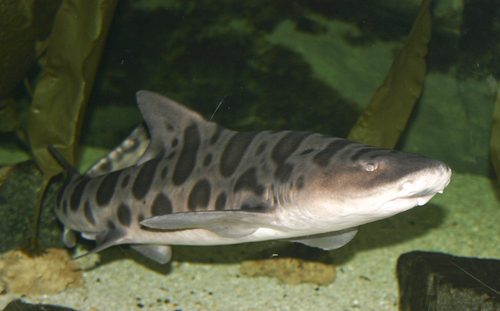
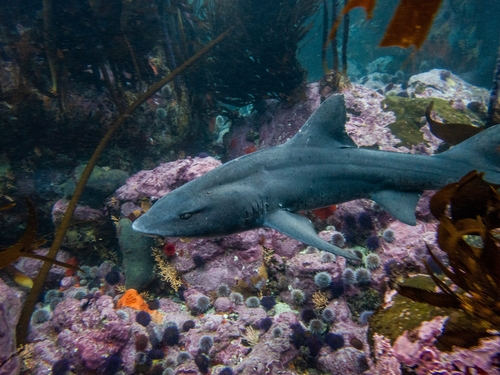
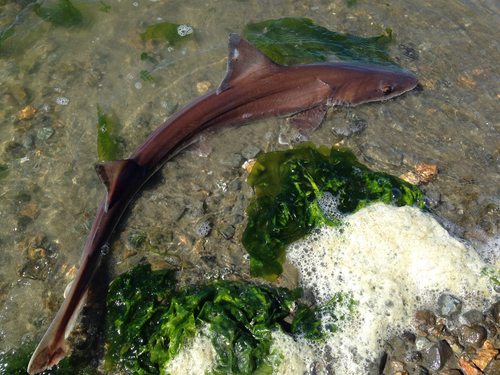
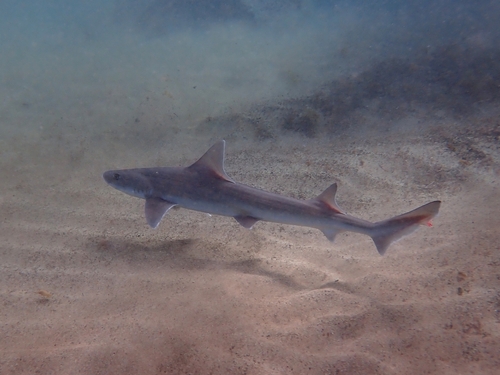
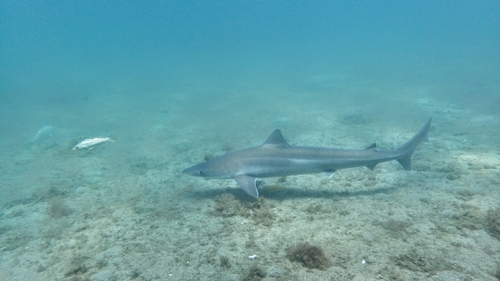
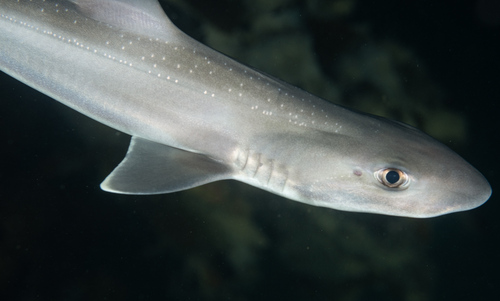
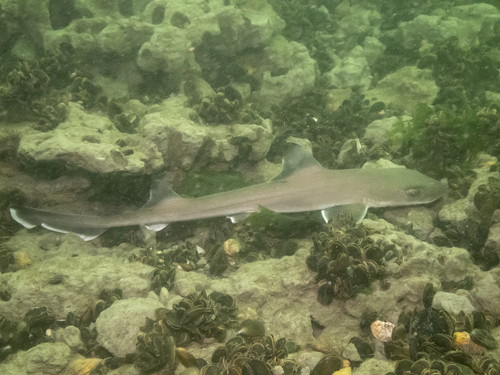
The dusky smooth-hound (Mustelus canis), also commonly called the smooth dogfish or dog shark, is a species of houndshark belonging to the family Triakidae. This shark has an olive grey or brown body, and may also show shades of yellow or grayish white. Females of this species live up to 16 years, while males have a maximum lifespan of 10 years. M. canis was the first shark species that was recognized to experience viral infections. M. canis inhabits marine and brackish waters, and is both a demersal (bottom-dwelling) and oceanodromous (sea-migratory) species. Its geographic range falls between 42°N and 44°S latitude, and 100°W and 46°W longitude. Populations of M. canis in the North Atlantic migrate in response to changing water temperatures. In winter, they occur from the Carolinas to the outlet of Chesapeake Bay, and in summer they range from the mid-Atlantic to southern New England. They are most abundant along the East Coast of the Americas, from Massachusetts to Florida, Brazil to Argentina, and in the Gulf of Mexico. They are mostly found in waters shallower than 60 ft (18 m), but can occur as deep as 665 ft (200 m). The mating season of smooth dogfish runs from May to June. They are viviparous and have a yolk-sac placenta. Females can store sperm for up to a year, though how long stored sperm remains usable is not known. Their gestation period lasts 10 to 11 months, and litters contain between four and 20 pups. Newborn pups measure 13 to 15 in (34 to 39 cm) long. Males reach sexual maturity between 2 and 3 years of age, or when they reach 68 to 93 cm in length. Females reach sexual maturity between 4 and 5 years of age, or when they reach 70 to 130 cm in length. Smooth dogfish have a relatively slow population doubling time, ranging from 4.5 to 14 years. Due to their late sexual maturation, low fecundity, and restricted distribution, they are more vulnerable to overfishing than teleost fishes. Juvenile female smooth dogfish have filiform uteri, small ovaries holding undifferentiated oocytes (egg cells), and narrow, thread-like oviducts with underdeveloped oviducal glands. Adolescent females have enlarged oviducal glands with distinguishable oocytes, and no or very few corpora lutea. Adult females have large ovaries and vitellogenic oocytes. Spermatozoa have been observed in preovulatory females. Juvenile males have small, soft claspers, underdeveloped testes, and straight, thread-like ampullae ductus deferens. Adolescent males have heavier testes, and extended, calcified claspers that remain flexible. Adult males have fully formed, calcified claspers and large, fully developed testes.