About Mustelus californicus Gill, 1864
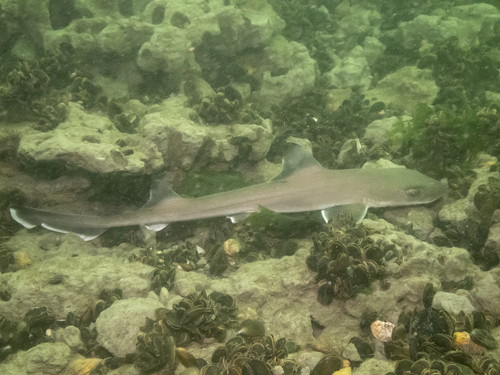
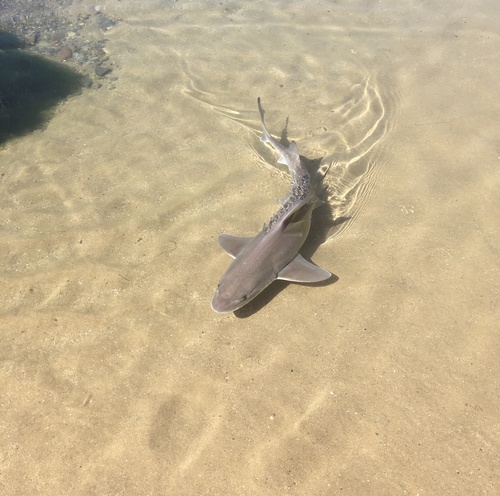
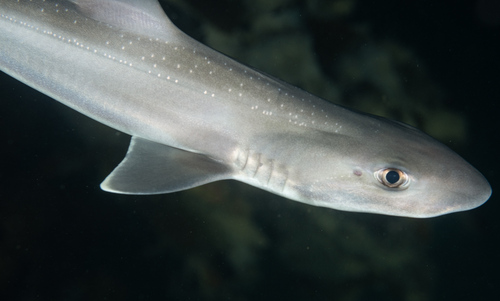
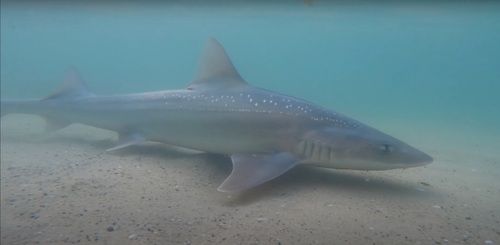
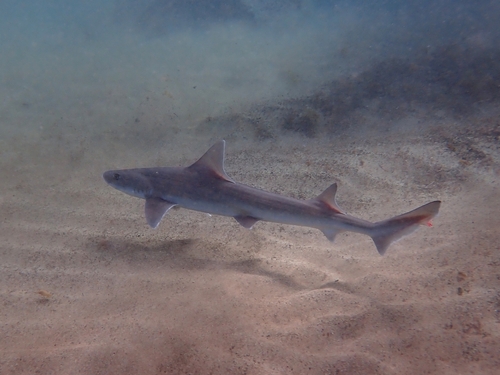
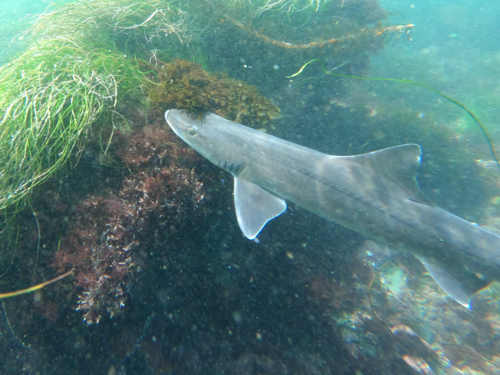
Mustelus californicus, commonly called the gray smooth-hound, is a medium-sized, spotless shark with a short, narrow head. Like other species in its genus, it has a slender body, a long blunt snout, conspicuous sub-ocular ridges, and dorsolateral positioned eyes. Gray smooth-hounds are brown to dark-gray on their dorsal (upper) side and white on their ventral (under) side. The lower ventral lobe of their caudal (tail) fin is poorly developed, and their second dorsal fin is relatively small. This species can be distinguished from other Mustelus species by its snout shape and the placement of its dorsal fin. It is often confused with the brown smooth-hound (Mustelus henlei), but the two species have several consistent distinguishing traits. In gray smooth-hounds, the midpoint of the dorsal fin is closer to the origin of the pelvic fin than to the tip of the pectoral fin; in brown smooth-hounds, this midpoint is equally distant between the two fins. Tooth shape differs slightly between the two: gray smooth-hounds have smooth, blunt, non-cusped teeth, while brown smooth-hounds have a basal cusp on the sides of their middle upper teeth. The sides of the gray smooth-hound’s lower jaw (mandible) are concave, while those of the brown smooth-hound are slightly convex. The posterior edge of the brown smooth-hound’s dorsal fin is scaleless and frayed, which is not the case for the gray smooth-hound, and brown smooth-hounds have three-pronged tricuspid scales on their sides, a trait not seen in gray smooth-hounds. All tooth and scale differences require magnification to observe. Another congeneric species, the sicklefin smooth-hound (Mustelus lunulatus), is easily distinguished by its pointed lower caudal fin lobe, a feature absent in the gray smooth-hound; sicklefin smooth-hounds also have a longer snout, shorter upper labial furrows, and more widely spaced eyes. The white-margin fin smooth-hound (Mustelus albipinnis) has white fin margins that the gray smooth-hound lacks, and the sharptooth smooth-hound (Mustelus dorsalis) has higher-cusped teeth than the gray smooth-hound. Mature gray smooth-hounds reach a total length of 50 to 160 cm (19.7-63.0 in). Females mature at a larger size and reach a larger maximum reported size than males. Newborn gray smooth-hounds measure 20 to 30 cm (7.9-11.8 in) long at birth. The gray smooth-hound occurs in warm coastal waters from Cape Mendocino, California, USA, south to Mazatlán, Mexico, along the coasts of California and Baja California. Populations in warm waters of Mexico and Southern California do not migrate, but sharks in colder northern waters migrate to central-northern California in summer, then return to more southern regions for the remainder of the year. Gray smooth-hounds are bottom-dwelling sharks that inhabit continental shelves, shallow muddy estuaries, and coastal bays, and they also occur within the Gulf of California. In California, this shark is most commonly found in shallow waters less than 12 meters (39 ft 4 in) deep, though it has been recorded to a maximum depth of 67 meters (219 ft 10 in). In the Gulf of California, most gray smooth-hounds are found at depths less than 80 meters (262 ft 6 in), but they have been recorded as deep as 265 meters (869 ft 5 in). Confirmed important nursery grounds for the species include the Biosphere Reserve of the upper Gulf of California, the Colorado Delta, Elkhorn Slough, and the Full Tidal Basin in Bolsa Chica. After restoration efforts at the Full Tidal Basin, gray smooth-hounds have become seasonally abundant there in summer, and the local population at this site is mostly made up of juveniles. Juveniles at this site are most often found at the edges between eelgrass patches and muddy substrates; eelgrass habitats host many of the gray smooth-hound’s prey items. Most gray smooth-hounds select warmer habitats in the middle of the basin during the day, then move into cooler habitats where their prey occurs at night, a pattern thought to help them thermoregulate. Water dissolved oxygen levels are also thought to influence their movement patterns. The gray smooth-hound is a viviparous (live-bearing) shark. During embryonic development, the yolk sac differentiates into a yolk sac placenta that facilitates nutrient and gas exchange between the mother and developing embryos. Like other smooth-hound species, gray smooth-hounds reproduce annually, with an estimated gestation period of 9 to 12 months. Litters can contain between 3 and 17 pups. Due to an early age at maturity, large litter sizes, and yearly reproduction cycles, gray smooth-hounds have a high reproductive output. The sex ratio of pups per litter is approximately equal, at a 1:1 ratio of males to females. There is a positive linear relationship between maternal total length and litter size: longer females produce larger litters. Gray smooth-hound females have oviducal glands that allow sperm storage from multiple matings, which has led to the hypothesis that females are polyandrous (mate with multiple males), but this has not been confirmed. The only existing study of the gray smooth-hound’s mating system was published in 2021, which genetically analyzed pups from two small sampled females. The study found that both females were genetically monogamous, meaning all of a female’s offspring were sired by a single male. Two explanations for this finding have been proposed: first, females may use post-copulatory mechanisms such as sperm competition and cryptic female choice to select sperm from only one male to fertilize eggs, resulting in genetic monogamy even if the species is polyandrous; second, the small sampled females may simply have avoided multiple mating encounters, which would also produce genetic monogamy. It is also possible that females can selectively abort embryos with low fitness. Other smooth-hound species generally have low to moderate levels of multiple paternity (females carrying offspring sired by multiple males), so if genetic monogamy is confirmed for gray smooth-hounds, this trait would make the species unique within its genus. Because current information on the gray smooth-hound’s mating system comes from a single study with a very small sample size, more research is needed to fully understand whether this species engages in multiple matings and whether it is consistently genetically monogamous.