About Mustela sibirica Pallas, 1773
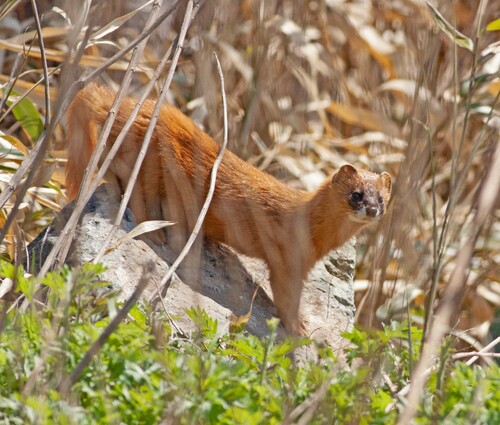
The Siberian weasel (Mustela sibirica Pallas, 1773) has a long, stretched body with relatively short legs. Its head is elongated, narrow, and relatively small, with short ears that are broad at the base. The tail is half the length of the body. Winter fur is very dense, soft, and fluffy, with guard hairs measuring 3–4 cm (1.2–1.6 in) long. The underfur is dense and loose fitting. Siberian weasels are monotone in color, overall bright reddish-ocherous or straw-red, though orange or peach tones sometimes appear on the coat; these tones are especially bright on the back, while the flanks and underbelly are paler. A dark, coffee-brown mask is present on the face. Their tails are more brightly colored than the back, and are fluffier than the tails of other species in the Mustela genus. The lips and chin are white or slightly ochreous. The front of the muzzle is darker than the rest of the head. Its skull is intermediate in form between the skulls of stoats and minks: it is longer and larger than a stoat's skull, but somewhat more flattened than a mink's skull. Adult males measure 28–39 cm (11–15 in) in body length, while adult females measure 25–30.5 cm (9.8–12.0 in). Male tails reach 15.5–21 cm (6.1–8.3 in) in length, while female tails reach 13.3–16.4 cm (5.2–6.5 in). Males weigh 650–820 g (23–29 oz), while females weigh 360–430 g (13–15 oz). Exceptionally large individuals have been sighted in the Baraba steppe.
The Siberian weasel's native range extends from the Himalayas in Pakistan, India, Nepal and Bhutan to northern Myanmar, northern Thailand, Laos, Taiwan, China, and Korea. In Russia, it occurs in Kirov Province, Tataria, and from the western Urals through Siberia to the Russian Far East. It has been introduced to the Japanese islands of Honshu, Shikoku and Kyushu.
The rutting period of the Siberian weasel varies by location. In western Siberia, rutting begins in early February to late March. In Primorye, it begins in early March to late April. Six pairs of Siberian weasels held at a fur state farm near Moscow entered rut between 25 April and 15 May. Siberian weasels mate repeatedly during a 35-minute period. Gestation lasts 38–41 days, with one recorded case of a female giving birth after only 28 days. Litters contain 4–10 kits. Kits are born blind, and are sparsely covered in white hair. They develop light yellow hair after a few days, and open their eyes after one month. They suckle for two months, and become independent by late August. By this time, the young are almost fully grown to adult size, but still retain their deciduous teeth and have lighter bones. Their fur is darker than the fur of adult Siberian weasels.