About Mustela itatsi Temminck, 1844
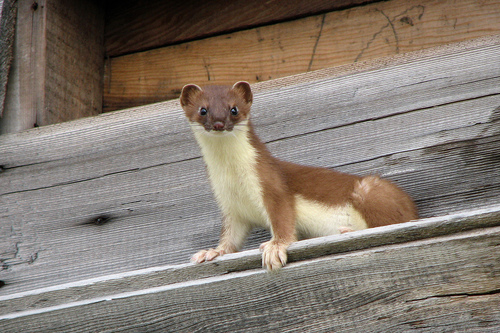
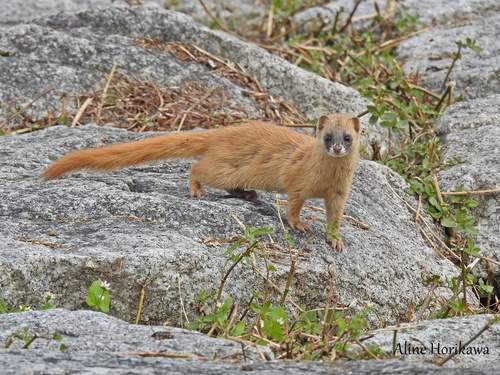
The Japanese weasel (Mustela itatsi) is a carnivorous mammal in the Mustela genus of the Mustelidae family. Its closest relative in the Mustela genus is the Siberian weasel (Mustela sibirica). The species epithet itatsi derives from itachi, the Japanese word for weasel. This species is native to Japan, where it is found on the islands of Honshū, Kyūshū, and Shikoku. It has been introduced to Hokkaidō, the Ryukyu Islands, and Russia's Sakhalin Island, originally to control rodent populations. The Japanese weasel has an orange-brown fur coat with darker markings on the head, and its size varies by gender. It has a long, slender body, a long tail, relatively short legs, and sharp claws. It is frequently confused with the Siberian weasel, but the two differ in the ratio of tail length to head-and-body length: the Japanese weasel has a tail ratio of 36–50%, while the Siberian weasel has a tail ratio greater than 50%. Unlike many other weasel species, the Japanese weasel's coat does not change colour in winter. The species' average lifespan is heavily dependent on food availability, with other factors having a smaller effect. In the wild, Japanese weasels live 2 to 3 years, with the oldest recorded individuals reaching around 5 years of age. Over the last three generations, the Japanese weasel population has declined by 25%, which has led to its classification as Near Threatened on the IUCN Red List. As a conservation measure, the Japanese government has banned the hunting of female Japanese weasels. Some taxonomic treatments classify the Japanese weasel as a subspecies of the Siberian weasel, but the two are now recognized as separate species. While they are very similar in appearance, they differ in tail-to-head-body length ratio, and have genetic differences that indicate they diverged roughly 1.6–1.7 million years ago, during the Early Pleistocene, according to mitochondrial sequence data. Their geographic ranges now overlap in western Japan, where the Siberian weasel has been introduced. Adult male Japanese weasels can reach a body length of 35 cm (14 in), with a tail up to 17 cm (6.7 in) long; females are smaller than males. Japanese weasels are sexually dimorphic, with males weighing approximately three times as much as females, though there is no significant difference in tail ratio between the sexes. The species typically lives in mountainous or forested areas near water, and can also be found in grasslands, shrublands, and plantations. It inhabits both natural and secondary forests, is not strongly affected by altitude, and has an upper elevation limit of 336 metres (1,000 ft). Due to their thin fur and long body shape, nest selection is important for Japanese weasels. Females and males differ in nest selection: females need habitats with higher quality food than males, because they must feed themselves and their offspring. Historically widespread across Japan, the Japanese weasel has disappeared from most of lowland western Japan, where the introduced Siberian weasel has become the dominant mustelid. It is not typically found in large cities, and is entirely absent from urban Tokyo. Many Japanese weasels are killed on roads, and coexistence with human settlements presents a mortality risk to the species. When human activity decreases in rural areas, Japanese weasels return to those regions; this has been observed in rural parts of Oita, Japan, and the largest population declines continue to be seen in western Japan. Both sexes have anal glands that produce a strong-smelling secretion called musk, which they use to repel predators by rubbing the secretion on rocks, branches, and other natural surfaces. Japanese weasels reach sexual maturity before one year of age, and give birth to four to five offspring per litter. Offspring are weaned at 8 weeks old. The diet of the Japanese weasel includes mice, frogs, reptiles, insects, and crayfish. In winter, Japanese weasels help protect tree saplings by hunting rodents that chew on sapling roots, when hibernating snakes and inactive owls cannot control rodent populations.